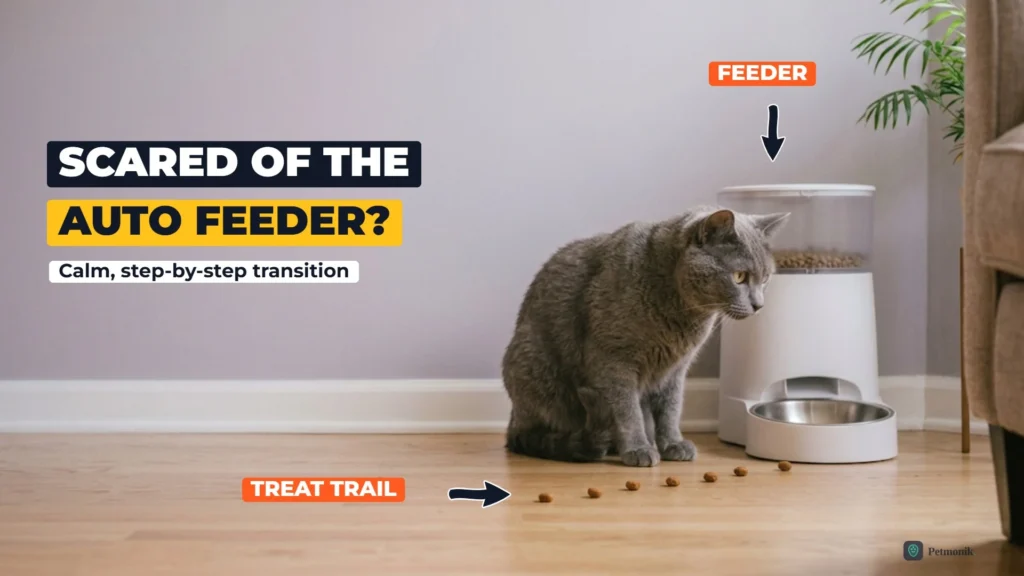
Most cats accept an automatic feeder within days if you introduce it gradually, and even nervous ones adjust within a few weeks — this guide covers exactly how. A motorized feeder solves real problems, from early wake-up calls to meals while you’re at work, but many cats bolt the first time the motor whirs or a lid swings open. That reaction is normal, and it’s fixable. We used the gradual approach veterinary behaviour guidance recommends for fearful cats, and the steps below let your cat set the pace.
One rule runs through every step: never use hunger to force the change. Keep your cat’s usual bowl available until the feeder is accepted, and call your vet if your cat eats noticeably less at any point.
Table of Contents
How to Transition Cat to Automatic Feeder: Why Cats Resist at First
Cats are wired to be cautious about new things near their food. In the wild, a meal is also a moment of vulnerability, so an object that suddenly makes noise or moves right where they eat reads as a threat, not a convenience.
Three things about motorized feeders set off that caution:
Sudden sound. The motor, the rattle of kibble dropping and any recorded “meal call” all happen without warning, often while your cat is standing right at the bowl.
Movement. Feeders with lids that open and close, such as RFID models, add motion at face height.
Change itself. The AAFP and ISFM feline environmental needs guidelines stress predictable routines and giving cats choice and control. A new device in the feeding spot removes both at once, and a feeder placed beside a noisy appliance, a busy doorway or the litter box adds even more stress.
A cat that is startled once can learn to avoid the feeder entirely, and punishment or pressure makes fear worse, as the Merck Veterinary Manual notes. The fix is the standard behavioural approach for fear: desensitization (tiny, gradual exposure) combined with counterconditioning (pairing the scary thing with something your cat loves).
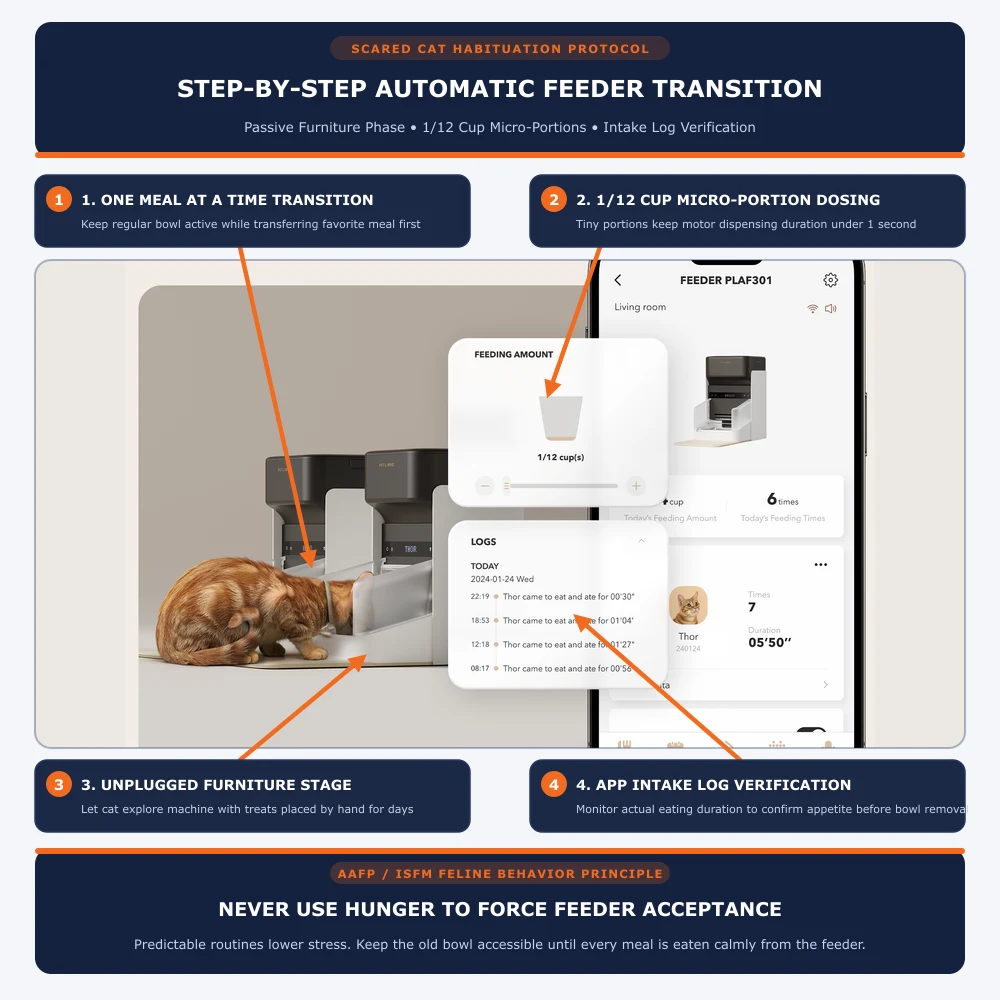
Source: PETLIBRO / Petmonik Protocol
Step 1 — Choose the Right Feeder for Anxious Cats
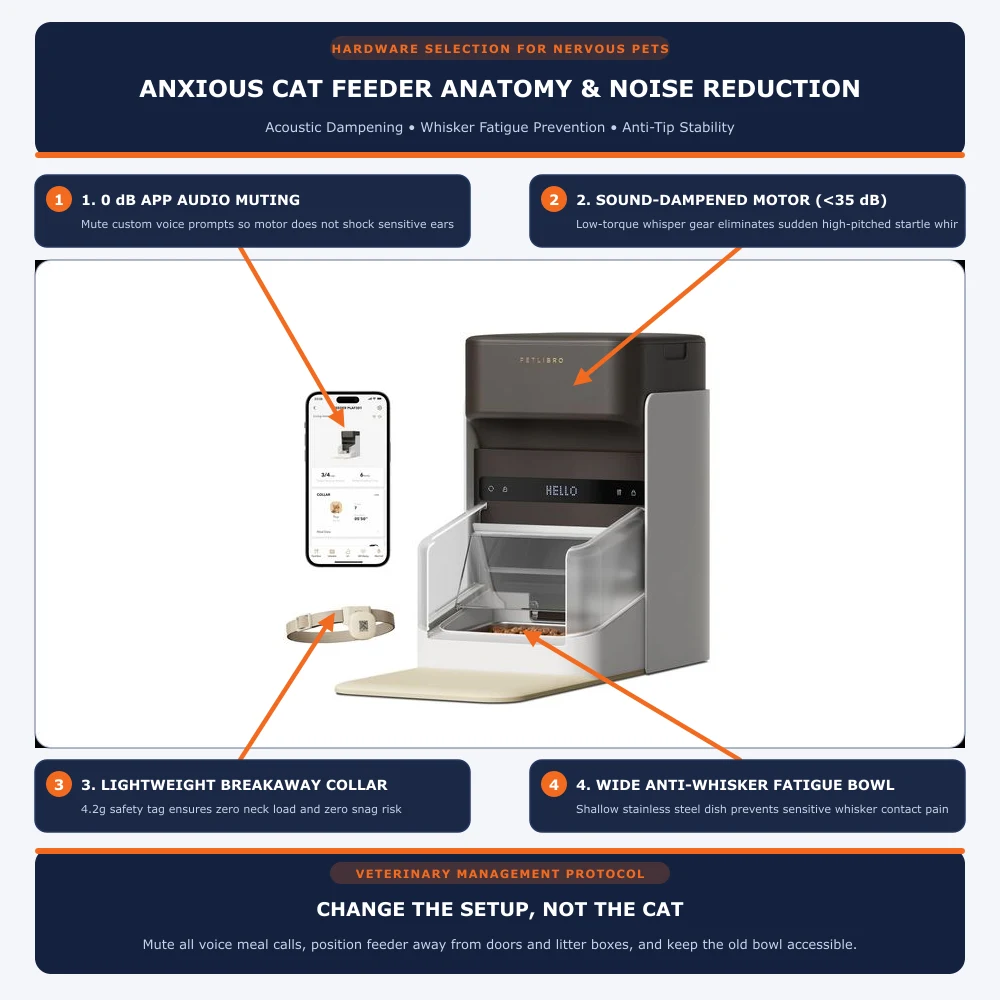
If you haven’t bought a feeder yet, a few features make the transition much easier for a nervous cat.
Sound you can switch off. Many feeders play a recorded meal call. Petlibro lets you customise it in the app and PETKIT lets you record your own voice; check you can disable it or use your own voice.
A bowl that sits away from the chute. Food should drop into the bowl without landing near your cat’s face.
A lid you can keep open. RFID feeders use a moving lid; pick one with an open or training mode, such as the Petlibro One RFID’s lid settings, so you can add movement later.
A stable, heavy base and a wide, shallow bowl. A feeder that wobbles or a bowl that tips is a second reason to be scared.
Small portion sizes. Dispensing a tiny portion means a short, quiet motor run during training.
For the first few days, the feeder is just furniture that happens to hold food. Keep it unplugged, with no batteries.
Place it in a quiet spot next to your cat’s usual bowl, away from the litter box and from busy doorways.
Leave the regular bowl in its usual place and keep feeding from it as normal.
Put a few favourite treats in the feeder’s bowl by hand, and add them again whenever they’re eaten.
If your cat is generally anxious, a cat pheromone diffuser near the feeding area, as the AAFP/ISFM guidelines suggest, can help.
Let your cat sniff and explore at their own pace. Don’t carry them to the feeder or hold them near it.
Once your cat eats treats from it calmly, serve part of a normal meal in the feeder’s bowl by hand.
Move on only when your cat eats from the feeder bowl without hesitating. For many cats that takes a few days; don’t hurry it.
Step 3 — First Motor Exposure
This is the step to go slowest on. Work below your cat’s fear threshold: if you see tensing, freezing, dilated pupils, flattened ears or a sudden change in breathing, you’ve gone too far. Stop and go back a stage.
Power the feeder on and mute every voice prompt and meal call.
While your cat is in another room or at the far side of this one, dispense the smallest portion from the app.
The moment the motor stops, give your cat a high-value treat, such as a lick of a favourite paste treat or a piece of freeze-dried meat.
Repeat two or three times a day, keeping sessions short. Move a little closer only when your cat stays relaxed several times in a row.
Once your cat stays calm nearby, dispense while they eat treats a short distance from the feeder.
The goal is a cat that walks toward the feeder when the motor runs. Don’t rush this; it can take a week or more.
Step 4 — Full Transition
Now the feeder starts doing its job, one meal at a time.
Pick the meal your cat is most eager for and let the feeder dispense it at the usual time, while you’re home to watch.
Keep the other meals in the old bowl for three to four days, then move a second meal to the feeder.
Keep meal times the same every day. Predictable routines lower stress, and cats quickly learn when the feeder will run.
Keep the total daily amount the same as before; split it across more, smaller meals if your cat prefers grazing.
Check your cat actually eats each scheduled meal, using the feeder’s app logs, camera or your own eyes.
If your feeder has a lid, switch it from open mode to its normal setting only after a week of calm eating.
Remove the old bowl last, once every meal comes from the feeder and your cat’s intake hasn’t dropped.
What to Do If Your Cat Still Refuses After 2 Weeks
Two weeks is a checkpoint, not a deadline. If your cat still won’t eat from the feeder, work through these in order:
If you’re introducing an automatic feeder into a multi-cat household, pacing the rollout matters even more — see our picks for the best smart feeders for multiple cats.
Check the food intake first. If your cat is eating less overall, stop the transition, go back to the old bowl and call your vet. Cats that go without food for several days are at risk of hepatic lipidosis (fatty liver disease), which VCA Animal Hospitals notes typically follows three to four days of little or no eating, especially in overweight cats.
Go back one step. Refusal often means the motor exposure moved too fast. Return to the last stage where your cat was relaxed and progress more slowly.
Change the setup, not the cat. Try a quieter spot, turn off every sound the feeder makes, or keep a lid permanently open if your model allows it.
Rule out other stressors. In multi-cat homes, one cat may be guarding the feeder. The AAFP/ISFM guidelines recommend at least two separate feeding areas, away from the litter box.
Consider a different design. Some cats never accept a lid or a loud motor. An open-bowl feeder with a quieter mechanism may be the better fit; our round-up linked below compares options for multi-cat homes.
Talk to your vet about ongoing anxiety. If your cat is fearful in other situations too, your vet can check for medical causes and discuss whether a veterinary behaviourist or anti-anxiety medication could help.
Source: PETLIBRO / Petmonik Hardware Analysis
The bottom line: cats accept automatic feeders when the feeder becomes predictable and positive, never when they’re pushed. Keep the old bowl out, go slower than you think you need to and watch your cat’s body language, not the calendar. Petmonik will keep adding feeder-specific guides; if your cat needed a different approach, tell us through our contact page.
How do I get a scared cat used to an automatic feeder?
Go gradually and let your cat set the pace. Start with the feeder unplugged next to the usual bowl, with treats inside. Then power it on with every sound muted, dispense the smallest portion while your cat is at a distance, and give a high-value treat the moment the motor stops. Finally, move one meal at a time to the feeder while keeping the old bowl available.
How long does it take a cat to accept an automatic feeder?
Some cats accept a feeder within days, while nervous cats can take weeks. The first motor exposure step can take a week or more on its own. Two weeks is a checkpoint, not a deadline, so watch your cat’s body language rather than the calendar.
Why is my cat afraid of the automatic feeder?
Cats are cautious about new things near their food. Motorized feeders set that off in three ways: sudden sound from the motor, falling kibble or a recorded meal call, movement from lids that open and close, and the change itself. Veterinary guidance stresses predictable routines and giving cats choice and control, and pressure or punishment makes fear worse.
What should I do if my cat still refuses the feeder after two weeks?
Check your cat’s food intake first. If your cat is eating less overall, stop the transition, go back to the old bowl and call your vet, because several days of little or no eating can lead to fatty liver disease. Otherwise go back one step, try a quieter spot with every sound turned off, rule out other stressors, or consider a different feeder design. Talk to your vet if your cat is fearful in other situations too.
Should I take away my cat’s old food bowl when I start using an automatic feeder?
No. Keep the usual bowl available until the feeder is accepted, and never use hunger to force the change. Move meals over one at a time, keep meal times and the total daily amount the same, and remove the old bowl last, once every meal comes from the feeder and your cat’s intake hasn’t dropped.
Sam Kerrow is the lead editor and smart pet technology researcher at Petmonik. Focusing on multi-pet households, RFID and AI selective feeders, smart hydration fountains, and pet telemetry data, Sam tests device reliability, firmware behavior, and practical troubleshooting for cat and dog owners.