

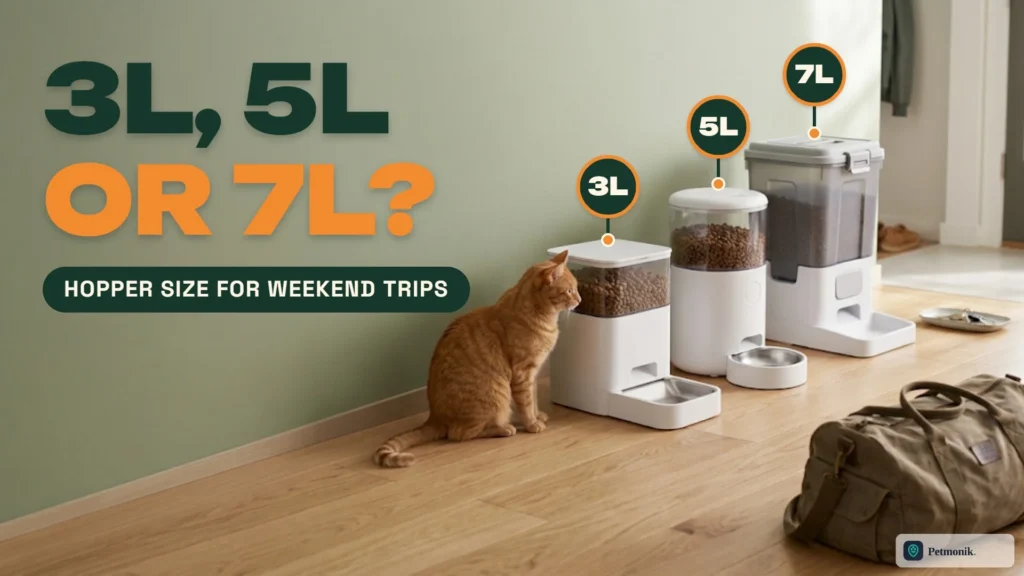
You are packing for a long weekend, and the feeder hopper looks half full. Is that enough? Or should you have bought the bigger one? Capacity numbers on the box are in liters, but your pet eats grams, and the gap between the two is where weekend trips go wrong. This automatic feeder capacity guide for a weekend turns 3L, 5L and 7L hoppers into days of food, using the brands’ own portion figures, so you can check the math for your pet before you leave. Because kibble density varies with shape and formula, treat liter-to-gram conversions as a baseline and weigh one test scoop of your own food before leaving. Use this automatic feeder capacity guide weekend checklist before you pack.
Quick Summary: Which Hopper Size Do You Need for a Weekend?
- Liters are not days. A hopper’s capacity in liters has to be converted to grams of your own food, then divided by your pet’s daily amount.
- Rule of thumb from brand figures: Petlibro and PETKIT both give a portion as about 10 g for roughly 1/12 cup, which works out near 500 g of kibble per liter. Your food may differ.
- For a weekend, 3L is usually plenty for a cat or small dog. Large dogs and multi-pet homes are where 5L or more matters.
- Capacity is not the only limit. Check portion and meal limits, kibble size, power backup and freshness.
How to Turn Liters Into Days of Food
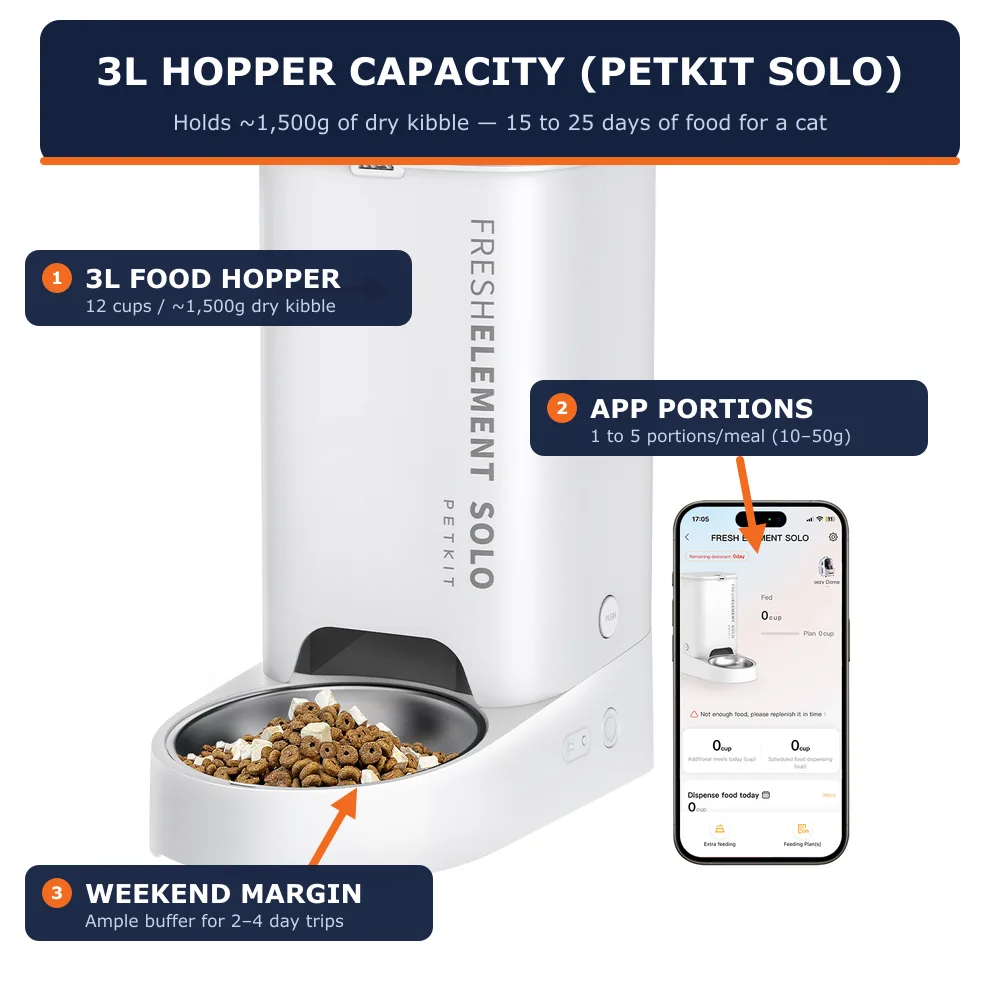
Two brand specifications let us estimate how much food a hopper holds. PETKIT says each portion of the Fresh Element Solo is about 10 g, roughly 1/12 cup, and lists the hopper as 3 liters or 12 cups. Petlibro says each portion on its 5L feeder is about 20 ml or 10 g, roughly 1/12 cup. Both imply that about 10 g of kibble takes up about 20 ml, or roughly 500 g per liter.
That gives a working formula:
- Estimated grams in a full hopper = liters x 500.
- Days of food = grams in the hopper / your pet’s daily grams.
- Your pet’s daily grams come from the food label or your vet, not from this guide.
This is an estimate. Kibble density varies by brand and shape, so weigh a measured scoop of your own food to confirm, and do not fill past the max line.
3L vs 5L vs 7L: Estimated Days of Food
The table below uses the 500 g per liter estimate and shows how many days a completely full hopper would last at example daily amounts. The example amounts are illustrations, not feeding recommendations.
| Daily food (example) | 3L (about 1,500 g) | 5L (about 2,500 g) | 7L (about 3,500 g) |
|---|---|---|---|
| 60 g (small cat) | About 25 days | About 41 days | About 58 days |
| 100 g (average cat or small dog) | 15 days | 25 days | 35 days |
| 200 g (medium dog) | About 7 days | About 12 days | About 17 days |
| 300 g (large dog) | 5 days | About 8 days | About 11 days |
| 500 g (very large dog) | 3 days | 5 days | 7 days |
A weekend trip is two to four days, so for a cat even a 3L hopper has a huge margin. The hopper size only becomes the deciding factor for large dogs or several pets sharing one feeder.
How Much Food Does a Weekend Actually Need?
| Daily food | 3 days | 4 days | Plus a 1-day safety buffer (4 days) |
|---|---|---|---|
| 60 g | 180 g | 240 g | 300 g |
| 100 g | 300 g | 400 g | 500 g |
| 200 g | 600 g | 800 g | 1,000 g |
| 300 g | 900 g | 1,200 g | 1,500 g |
| 500 g | 1,500 g | 2,000 g | 2,500 g |
Add a day of buffer for delayed flights, traffic or a late sitter. That is why a 3L hopper (about 1,500 g) is tight for a 300 g a day dog, and not enough for a 500 g a day dog on a four-day trip.
Published Capacity and Portion Specs by Model
| Model | Capacity | Portion size | Notes |
|---|---|---|---|
| PETKIT Fresh Element Solo | 3 L or 12 cups | About 10 g, 1/12 cup; 1 to 5 portions per meal (10 to 50 g) | Meals set in the app |
| Petlibro Granary 5L | 5 L (about 20 cups) | About 20 ml or 10 g, 1/12 cup; 1 to 50 portions per meal | 1 to 10 meals a day; kibble 2 to 15 mm; dry food only; low-food sensor |
| Petlibro Space (PLAF107) | 8 L (about 34 cups) | About 20 ml or 10 g, 1/12 cup; up to 50 portions per meal | Dry food only; vacuum-sealed hopper; kibble 2 to 18 mm |
| WOPET Pioneer Plus / 7L class | 7 L (about 29 cups) | About 10 g per portion (up to 20 to 40 portions per meal by variant) | Dry kibble 2 to 15 mm; suited to large dogs or multi-pet homes |
Note: PETKIT and Petlibro step directly from 5 L hoppers up to 8 L (the Petlibro Space PLAF107), while dedicated 7 L hoppers are offered by brands like WOPET; always confirm per-meal portion caps for your specific model.
Limits That Matter More Than Liters
Portion and Meal Limits
PETKIT’s Solo allows 1 to 5 portions per meal, which is 10 to 50 g. Petlibro’s 5L feeder allows up to 50 portions per meal, with 1 to 10 meals a day. If your dog needs a large meal, check that the per-meal maximum covers it. Petlibro says its 5L feeder is more suitable for small or medium pets, such as small dogs, cats and rabbits, than for larger dogs.
Kibble Size
Petlibro lists a kibble range of 2 to 15 mm for the 5L feeder and 2 to 18 mm for the Space. Very large or irregular kibble can jam a dispenser, so measure yours.
Freshness
A large hopper holds food for longer than you may want to keep it. If you only need a weekend, fill what you need rather than topping it to the line, and use fresh food. Our guide to desiccant bags in pet feeders covers keeping the hopper dry.
Power
A bigger hopper does not help if the power fails. See our battery backup guide for how long models run on batteries.
How to Choose: A Quick Decision Guide
- Cat, one pet, weekend trips: 3L is plenty. Pick on other features.
- Small dog, weekend or short trips: 3L works if the math fits; 5L gives a buffer.
- Medium or large dog: 5L or larger, and check the per-meal portion limit.
- Two pets, one feeder: add up both daily amounts before choosing.
- Longer trips (a week or more): use the days table and add a sitter as a backup.
If you are not sure a feeder is worth it at all, read whether you need an AI pet feeder. If you want video check-ins too, our feeder, camera and fountain bundle guide covers setups for travelers.
Pre-Trip Checklist for a Weekend Away
- Weigh a scoop of your pet’s food to confirm the grams-per-liter estimate.
- Work out food needed: daily grams x days, plus one day.
- Fill the hopper with fresh food, not past the max line.
- Set the meal schedule and run a test feed a few days before you leave.
- Install backup batteries if your model supports them.
- Check the Wi-Fi connection and the app alerts.
- Ask a neighbor or sitter to check in, and leave water and your vet’s number.
The bottom line: for a weekend, convert liters to grams, divide by your pet’s daily amount and add a day of buffer. For most cats a 3L hopper is more than enough, while large dogs need the 5L class or bigger. Capacity is only one limit, so check portion size, kibble size and power backup too. Run a full test meal two days before departure so there are no surprises while you are away.
Frequently Asked Questions
How much food does a 3L automatic feeder hold?
PETKIT lists its 3L Fresh Element Solo as 3 liters or 12 cups. Using the brands’ portion figures, that is roughly 1,500 g of kibble, though density varies.
How many days will a 5L feeder last?
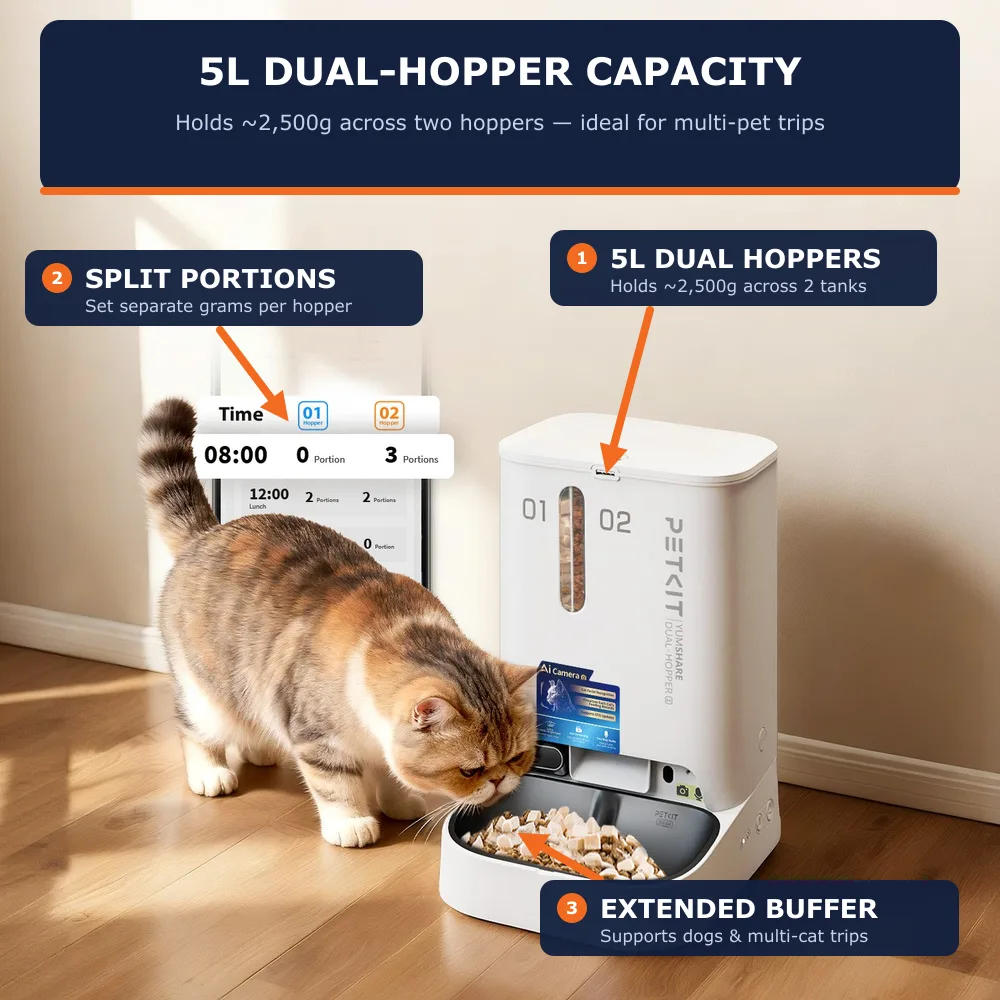
Roughly 2,500 g of kibble, so at 100 g a day it lasts about 25 days, and at 300 g a day about 8 days. Weigh your own food to confirm.
Is a 3L feeder big enough for a weekend trip?
For one cat or a small dog, yes, with a large margin. A big dog eating 300 g or more a day may need a larger hopper once you add a safety day.
Is a 7L feeder worth it?
Only if your pet or pets eat enough that smaller hoppers run short. For most households a bigger hopper mainly adds stale-food risk.
How do I calculate how much food I need for a trip?
Multiply your pet’s daily grams by the number of days and add one extra day as a buffer. Get the daily amount from the food label or your vet.
Can automatic feeders handle all kibble sizes?
No. Petlibro lists 2 to 15 mm for its 5L feeder and 2 to 18 mm for the Space. Very large kibble can jam, so check the range for your model.