AI & Selective Feeders

Wet Food Automatic Feeder Safety: Preservation & Temperature Explained

How long wet food is safe in an automatic feeder, how ice-pack and cooled feeders compare, and when a dry food feeder is the safer choice.

By Sam Kerrow Sam Kerrow Updated

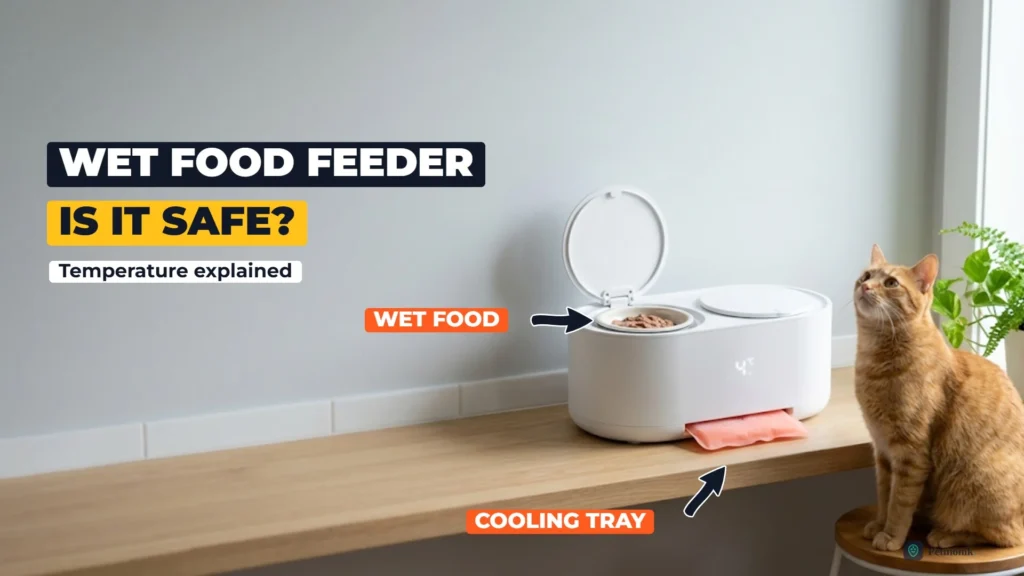
White wet food automatic feeder with an open food dish and a coral cooling ice pack, with a ginger cat looking up at it from a stool

Wet food needs either a refrigerated or ice-pack feeder, or a schedule that doesn’t leave it sitting out for hours — standard dry-food feeders weren’t built to handle it safely. Wet food is mostly water, spoils at room temperature, and a feeder that leaves it sitting in a tray for eight hours can do more harm than a missed meal. Yet many cats need wet food, including those on urinary or kidney diets and cats that barely drink — so we looked at what food-safety guidance actually says, how refrigerated feeders handle it, and when a dry food feeder is simply the safer choice.

Wet Food Automatic Feeder Safety: Why Standard Feeders Don’t Work

Most smart feeders dispense from a sealed hopper using an impeller or auger, and those mechanisms only work with dry kibble. PETKIT’s YumShare feeders, for example, accept dry kibble up to 12 mm, and Petlibro’s Granary and One RFID feeders take dry kibble between 2 and 15 mm. Wet food would jam the mechanism and contaminate the hopper.

If you’re feeding more than one cat, see our roundup of the best smart feeders for multiple cats on a prescription diet.

The deeper problem is time. Canned and pouched food is typically around 75 to 80 percent water, with protein and fat, which is exactly what bacteria need. Once a can is opened, the clock starts. A feeder only changes the risk if it keeps the food cold until the moment it’s served.

That leaves two workable designs for wet food:

  • Rotating tray feeders, which hold each meal in its own covered compartment and open one at a time on a timer.
  • Lidded bowls, which keep one meal covered until a pet arrives.

How Refrigerated Smart Feeders Solve This

Wet food feeders keep food cool in one of two ways.

Ice packs. Tray feeders such as the Cat Mate C300 and C500 hold frozen packs under the meal compartments. They’re cheap, simple and battery-powered, but the cooling fades as the packs thaw. Cats.com’s reviewer puts the C500’s twin packs at roughly 12 hours to a day of cooling; Closer Pets doesn’t publish a figure. Chewy owners of the C300 also point out that its last compartment doesn’t sit over the ice pack, so the final meal gets the least cooling.

Powered cooling. The Petlibro Polar uses a thermoelectric (Peltier) cooler, the same technology as small drinks coolers. Petlibro says it holds food at around 12°C (54°F) in a 25°C (77°F) room, keeps meals fresh for up to 72 hours, and pauses cooling about 30 minutes before each meal so the food isn’t served fridge-cold. It needs mains power; its backup batteries keep it running for 12 hours in a power cut.

Neither design reaches true refrigerator temperature. The FDA advises keeping refrigerated pet food at 40°F (4°C) or below. Ice packs start colder than that but warm up, and the Polar’s stated 54°F sits above it. Both slow spoilage; neither stops it.
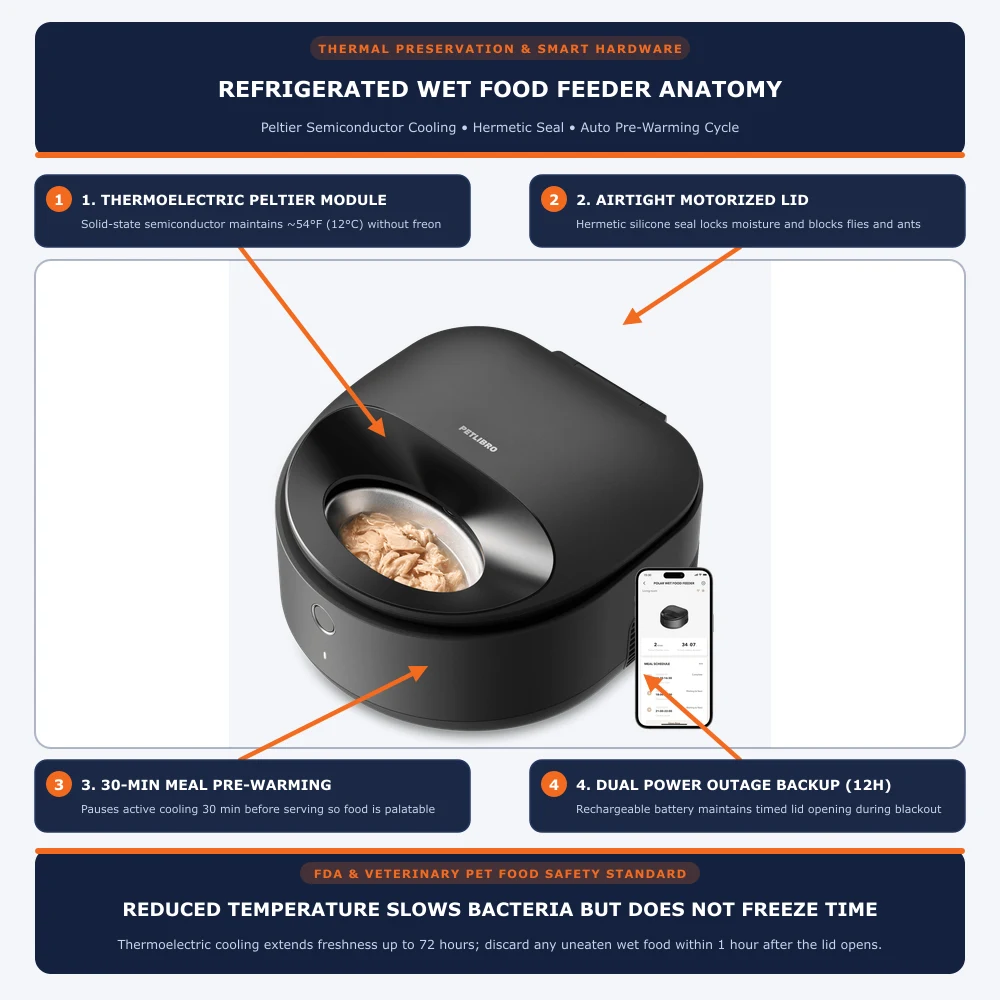
Technical diagram of refrigerated wet food automatic feeder showing thermoelectric Peltier cooling module, airtight motorized lid, 30-min pre-warming cycle, and battery backup
Source: PETLIBRO / Petmonik Thermal Analysis

Safe Temperature Window for Wet Food

There’s no single federal time limit for pet food left out, so we combined the FDA’s pet food guidance, the USDA’s food safety rules for perishable food and the manufacturers’ own advice:

Wet food left sitting out is also one of the biggest ant attractants — see our guide on keeping ants out of automatic feeders.

Where the food isHow long it’s safe
In the fridge, 40°F (4°C) or below, coveredUp to 3 days for opened food (Purina)
In the bowl at room temperatureUp to 1 hour (Purina); never more than 2 hours (USDA rule for perishable food)
In the bowl above 90°F (32°C)No more than 1 hour (USDA)
In a cooled feeder at around 54°F (12°C)Longer than room temperature, but not a substitute for a fridge

The reasoning: the USDA calls 40°F to 140°F (4°C to 60°C) the “danger zone,” where bacteria multiply fastest, and says perishable food shouldn’t stay there for more than two hours, or one hour above 90°F. Purina is stricter for the bowl itself, advising that wet food left out for more than an hour be thrown away. The FDA’s pet food guidance says to promptly refrigerate or discard leftover canned and pouched food, and to cover it tightly.

What that means for a feeder: time outside the cold zone adds up. A meal that sits in a thawing tray for six hours and then in the open bowl for another hour has been in the danger zone far longer than any of these limits. Our rule of thumb is to cool what you can, keep the gap between filling and serving as short as possible, and pick up whatever isn’t eaten within about an hour of serving. Follow your food’s label and your vet’s advice if they’re stricter.
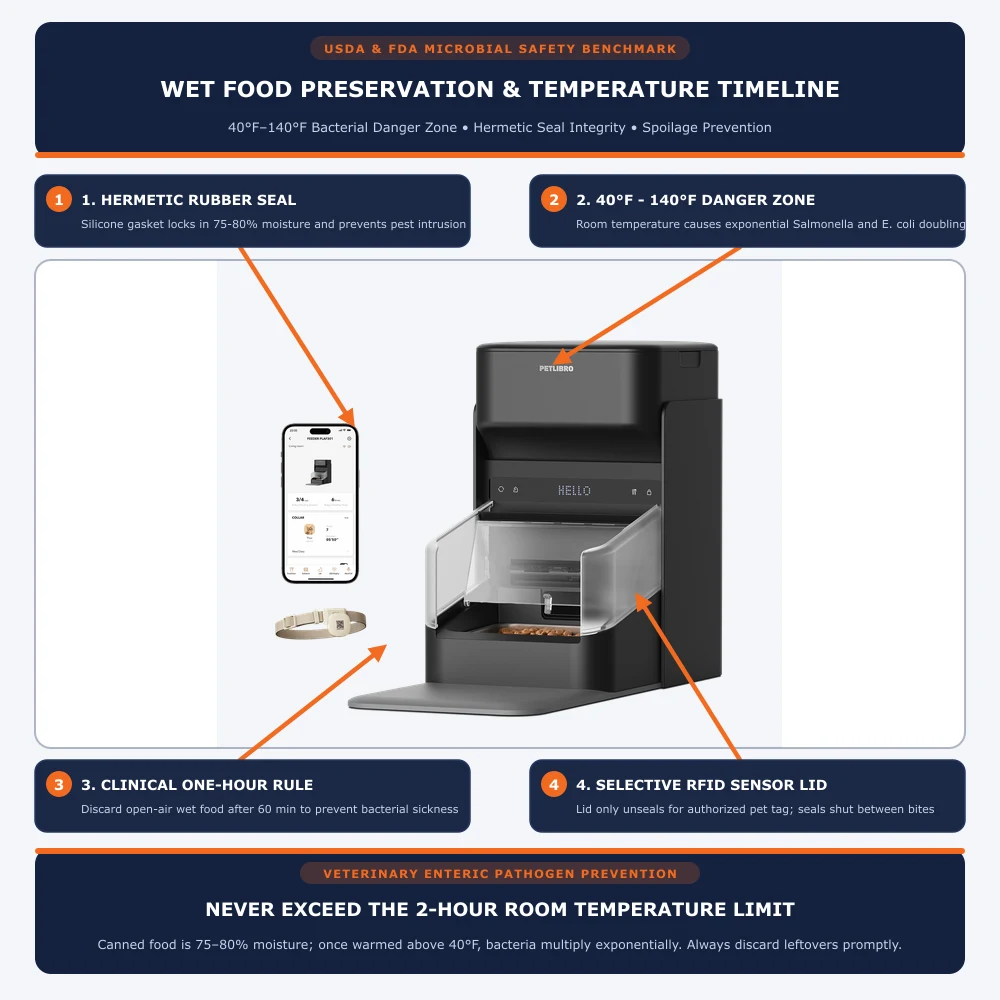
Veterinary wet food safety timeline illustrating 40F to 140F bacterial danger zone, hermetic rubber seal preservation, and 1-hour open bowl discard rule
Source: SureFeed / USDA / Petmonik Safety Guidelines

Best Wet Food Feeders Currently Available

  1. Step 1: Petlibro Polar Wet Food Feeder: Best Refrigerated

    The only powered, cooled wet food feeder we found from a mainstream brand. Its thermoelectric cooler keeps three meals chilled under a rotating lid, and the app handles schedules and feeding records. Cats.com’s reviewer liked the setup and app but noted condensation, a faint hum and a deep, plastic dish.

    • Cooling: Thermoelectric, about 12°C (54°F) in a 25°C room (Petlibro)
    • Meals: 3, up to 200 ml each
    • Power: Mains, with a 12-hour battery backup (3 AA)
    • Connectivity: 2.4 GHz WiFi app
    • Warranty: 24 months
    • List price: $169.99

    Check price

  2. Step 2: Cat Mate C500: Best Ice-Pack Feeder

    A five-compartment rotating tray with twin ice packs and a digital timer for up to four timed meals. It runs on batteries, so it can go anywhere, and the lid and tray are dishwasher safe. Cooling fades as the packs thaw, so it suits a working day better than a weekend.

    • Cooling: Twin ice packs
    • Meals: 5 compartments, up to 4 timed
    • Power: 3 AA batteries
    • Connectivity: None (on-device timer)
    • List price: $49.99 at Closer Pets

    Check price

  3. Step 3: Cat Mate C300: Best Budget

    A smaller three-compartment version with a single ice pack: one meal is available straight away and two open on the timer. Chewy owners rate it 4 out of 5 across 210 reviews, but note that the last compartment doesn’t sit over the ice pack, so serve the most perishable meal first.

    • Cooling: One ice pack
    • Meals: 3 compartments, each about 3/4 lb
    • Power: 3 AA batteries (about 12 months)
    • Connectivity: None (on-device timer)
    • List price: $46.99 at Chewy

    Check price

  1. Step 4: SureFeed Microchip Pet Feeder: Best for Multi-Cat Homes

    Not a timed feeder and not cooled, but the best option when several cats share a home and only one should eat a wet or prescription meal. The lid opens only for registered microchips or tags, and Sure Petcare says the sealed bowl keeps food fresher and free of flies. Fill it at mealtime and clear leftovers promptly.

    • Cooling: None (sealed lid)
    • Meals: 1 bowl, 400 ml
    • Power: 4 C batteries
    • Access: Microchip or RFID tag, up to 32 pets
    • List price: $208.95 at Chewy

    Check price

Dry Food Feeders — When They’re the Better Choice

Dry food is far more forgiving. It’s shelf-stable, and the FDA’s guidance is simply to keep it in a cool, dry place below 80°F, in its original bag with the top folded down. Sealed hoppers with desiccant packs extend that further, so a dry food feeder can safely cover a long weekend.

A dry food feeder is the better choice when:

  • You’re away for more than 24 hours. No wet food feeder we found is designed to keep food safe for several days without topping up.
  • Your cat eats dry food happily and has no medical need for wet food.
  • You need several small meals a day. Hopper feeders handle up to 10 portions a day; tray feeders are limited to their compartments.
  • You want per-pet tracking or access control. Almost every camera and RFID feeder is dry food only.

If your vet recommends wet food for hydration or a urinary or kidney diet, don’t switch to dry just because it’s easier to automate. Automate the dry part of the diet, if any, and serve the wet meals yourself or with a cooled feeder for short gaps.

Our Verdict

Match the feeder to your food and your schedule:

Your situationOur recommendation
Wet food, away for a working dayAn ice-pack tray feeder (Cat Mate C300 or C500), with packs frozen overnight
Wet food, overnight or an early breakfastPetlibro Polar, filled the evening before
Wet food, several cats or a prescription dietSureFeed Microchip Pet Feeder, filled just before mealtime
Away for more than 24 hoursA dry food feeder, or a pet sitter for wet meals
Dry food onlyA sealed hopper feeder with a desiccant pack

The bottom line: no automatic feeder makes wet food as safe as a fridge. Cooled feeders buy you hours, not days, so use them to bridge a workday or a night, and pick up leftovers promptly. For longer absences, dry food automation is the safer choice. Petmonik will update this guide as new wet food feeders reach the market; if you’ve found a setup that works, tell us through our contact page.

Frequently Asked Questions

Can automatic feeders handle wet cat food?

Standard hopper feeders can’t. Their impeller or auger works only with dry kibble, and wet food would jam the mechanism and contaminate the hopper. Two designs work for wet food: rotating tray feeders that hold each meal in a covered compartment and open one at a time on a timer, and lidded bowls that keep one meal covered until a pet arrives.

How long can wet cat food safely sit out?

Purina advises up to one hour in the bowl at room temperature, and the USDA says perishable food should never sit out more than two hours, or one hour above 90°F (32°C). Opened wet food keeps up to three days in the fridge at 40°F (4°C) or below, covered. A cooled feeder buys more time than room temperature but is not a substitute for a fridge.

How do refrigerated wet food feeders keep food cool?

Some use ice packs, like the Cat Mate C300 and C500, and the cooling fades as the packs thaw. The Petlibro Polar uses a thermoelectric cooler that Petlibro says holds food at around 12°C (54°F) in a 25°C room. Neither reaches refrigerator temperature, which the FDA puts at 40°F (4°C) or below, so use them to bridge a workday or a night, not days.

When is a dry food feeder the better choice?

When you’re away for more than 24 hours, your cat eats dry food happily with no medical need for wet food, you need several small meals a day, or you want per-pet tracking or access control, since almost every camera and RFID feeder is dry food only. If your vet recommends wet food, don’t switch to dry just to automate it.

What is the best automatic feeder for wet food?

It depends on your schedule. For a working day, an ice-pack tray feeder such as the Cat Mate C300 or C500 with packs frozen overnight. For an overnight or early breakfast, the Petlibro Polar filled the evening before. For several cats or a prescription diet, the SureFeed Microchip Pet Feeder, filled just before mealtime. For more than 24 hours away, use a dry food feeder or a pet sitter for wet meals.

Sam Kerrow
Written by

Sam Kerrow

Lead Hardware & Pet Tech Editor

Sam Kerrow is the lead editor and smart pet technology researcher at Petmonik. Focusing on multi-pet households, RFID and AI selective feeders, smart hydration fountains, and pet telemetry data, Sam tests device reliability, firmware behavior, and practical troubleshooting for cat and dog owners.

Leave a Reply

Your email address will not be published. Required fields are marked *