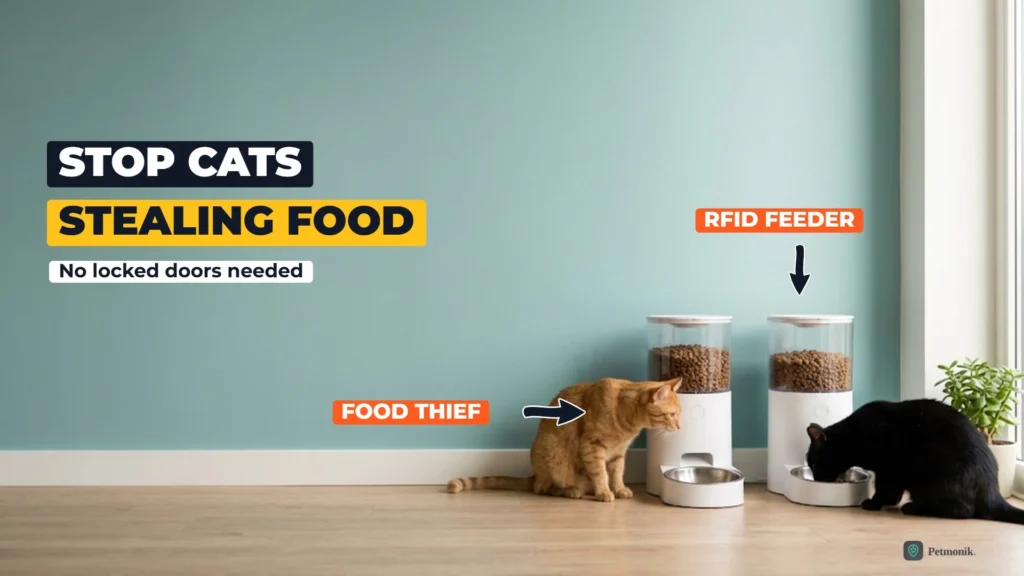
Four solutions fix cats stealing each other’s food without locking anyone behind a door, and we’ve ranked them below so you can pick the right one for your home. In most multi-cat homes, one cat finishes first and then helps itself to everyone else’s bowl — which looks harmless but isn’t: a cat on a prescription kidney, urinary, or weight-loss diet only benefits if it eats that food and nobody else does, while a food thief gains weight and a timid cat quietly goes hungry.
How to Stop Cats Stealing Each Other Food: Why It Happens
Cats evolved as solitary hunters that eat many small meals alone. Putting two or three of them around shared bowls at the same moment goes against that, so some cats compete while others back off. Common triggers:
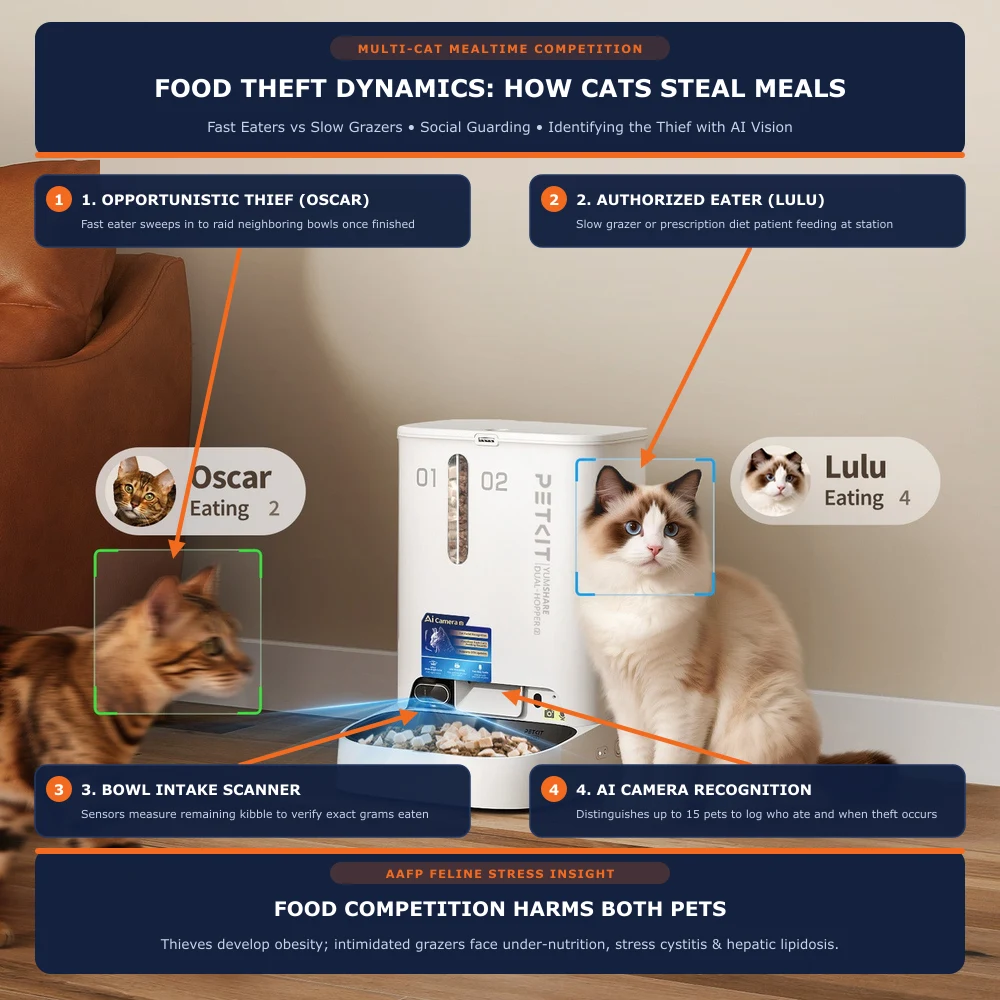
Different eating speeds. A fast eater finishes, then moves on to the nearest unguarded bowl.
Free-feeding. Food left out all day rewards whichever cat is most persistent.
Social tension. Confident cats may guard feeding spots, and anxious cats avoid them.
Tastier food next door. A cat on a restricted diet often prefers what the others are eating.
The American Association of Feline Practitioners (AAFP), in its 2018 consensus statement on feeding cats, links competition and stress around food to problems including obesity and cystitis, and notes that anxious cats that avoid other pets may not reach food often enough and lose weight. It recommends multiple feeding stations where each cat feels safe.
The stakes are highest when one cat is on a therapeutic diet. These foods are formulated for a specific condition, so every meal the patient loses to a housemate, and every meal a healthy cat eats instead, works against the treatment. Watch for the tell-tale signs: bowls emptied faster than usual, one cat hovering near the others at mealtimes, or weight moving in opposite directions across your cats. If any of your cats is losing or gaining weight without explanation, see your vet before you change anything else.
Source: PETKIT
Solution 1 — Microchip/RFID Selective Feeders
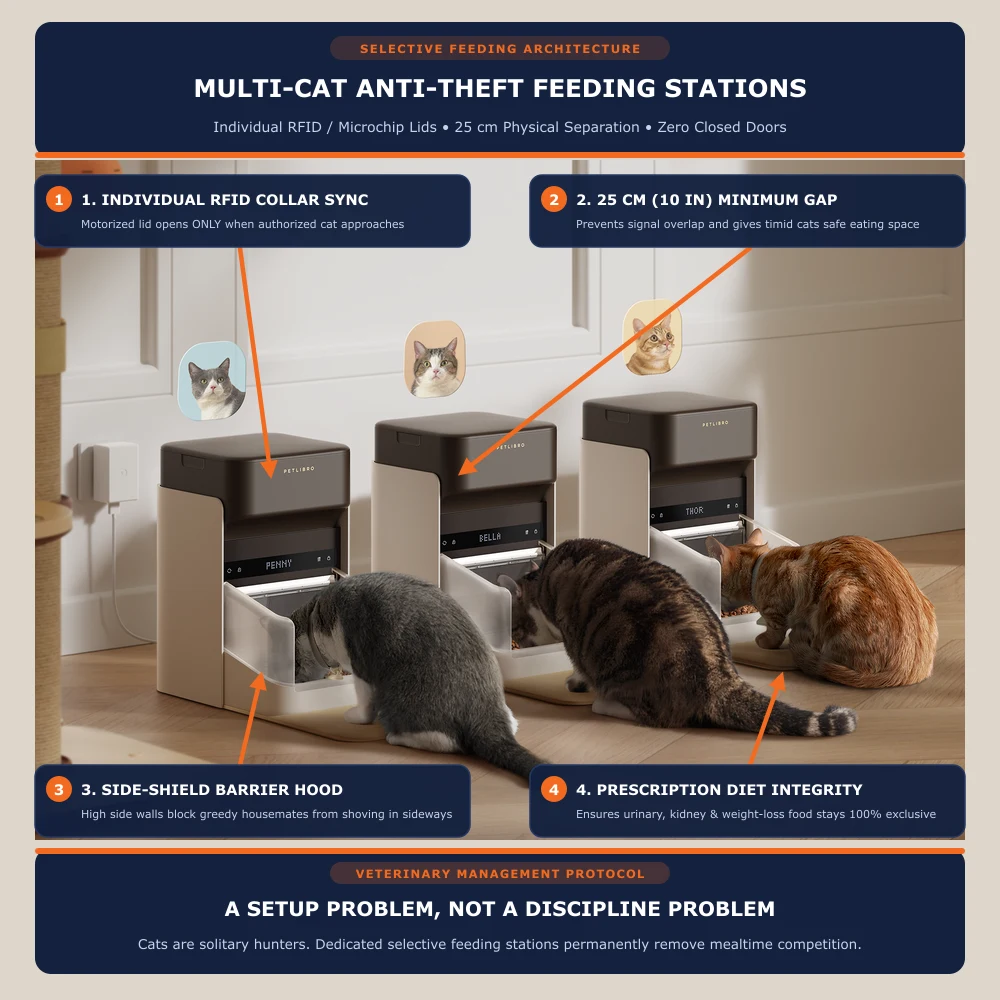
A selective feeder keeps its bowl covered until it detects a registered cat, then opens the lid and closes it again after the cat walks away. Two designs are common. Microchip feeders such as the SureFeed Microchip Pet Feeder read the chip already implanted in your cat, or an optional RFID collar tag, and can register up to 32 pets; SureFeed’s version runs on four C batteries and handles wet or dry food. Collar-tag feeders such as the Petlibro One RFID only open for their own tag, don’t read microchips and link to one tag per feeder.
The trade-offs are price and upkeep: Cats.com’s reviewer rated the SureFeed highly overall but marked it down for its cost and battery-only power.
Best for: cats on prescription or weight-loss diets, slow eaters and homes where only one or two cats need protecting.
Decide which cat or cats need protected access; you may only need one selective feeder.
Check your cats’ microchips are working (your vet can scan them at the next visit), or plan on collar tags if they aren’t chipped.
Register each allowed cat following the feeder’s instructions.
Use the training mode, if your model has one, so the lid movement doesn’t scare the cat.
Set the lid to close as quickly as your model allows once the registered cat leaves.
Place the feeder against a wall or in a corner. Cats.com’s reviewer found determined cats could swipe kibble through the SureFeed’s side gaps.
Solution 2 — Scheduled Separate Feeding Rooms
You don’t need locked doors, just separate spaces at mealtimes and no food left out in between. This costs nothing and works well alongside a selective feeder.
Switch from free-feeding to set meal times, several small meals a day if your cats are used to grazing.
Give each cat its own room or area at mealtimes, with the thief fed farthest from the others.
Serve every cat at the same moment, so nobody finishes first and goes looking.
Stay nearby for the first week to see who finishes first and who wanders.
Pick up every bowl after a set time, for example 20 to 30 minutes, so nothing is left to steal.
For a feeding room you can leave open, a microchip-activated pet door lets only the allowed cat through, with no locked doors or supervision.
If one cat is more agile, feeding them on a raised shelf the others can’t reach can replace a separate room.
Solution 3 — Feeding Station Placement Strategy
Where bowls sit often matters more than which bowls you use. The AAFP recommends multiple feeding stations, set up so each cat feels safe while it eats.
Provide at least one feeding station per cat. The AAFP/ISFM environmental guidelines go further and suggest at least two options for each resource.
Place stations out of sight of each other, in different rooms or on either side of a piece of furniture.
Keep them away from litter boxes, busy doorways and noisy appliances.
Give the timid cat the quietest spot, ideally one with a clear view of the room and an easy exit.
Slow down fast eaters with puzzle feeders or several small portions; the AAFP statement encourages small, frequent meals.
Change one thing at a time and watch for a week before changing the next.
Solution 4 — Camera Feeders with Portion Alerts
Camera feeders don’t stop a thief, but they show you exactly who eats what. The PETKIT YumShare Dual-hopper 2, for example, uses AI facial recognition to tell apart up to 15 pets, records which cat ate and when, compares before-and-after bowl images and flags changes in appetite. PETKIT notes it doesn’t physically block other cats, and video replay needs a subscription.
Set up a profile for each cat so the app can label every visit.
Check the log daily for the first two weeks and note who visits which bowl, and when.
Turn on the app’s notifications, including low-food and appetite-change alerts where your model offers them.
Use what you learn to target the fix, whether that’s a selective feeder for one cat or moving a station.
Compare the before-and-after bowl images at each prescription meal to spot the wrong cat finishing it.
Keep checking the diet cat’s records to confirm it eats its own food, and share the data with your vet.
Which Solution Is Right for Your Home
Most homes combine two of these. Use this as a starting point:
If you want a feeder that also keeps an eye on things while you’re out, a camera-equipped setup adds another layer of deterrence — see our guide to the best smart feeder camera and fountain bundle.
One cat is on a prescription or weight-loss diet: a selective feeder (Solution 1) for that cat, plus good station placement (Solution 3). If the diet is wet food, choose a microchip feeder designed for wet food.
Several cats need different diets: a microchip feeder that can register multiple pets, or one collar-tag feeder per restricted cat.
Healthy cats, mild competition: start with placement (Solution 3), then add scheduled meals (Solution 2). Both cost nothing.
You don’t know who’s stealing, or when: a camera feeder (Solution 4) for a couple of weeks gives you the evidence before you spend on anything else.
A very determined thief: combine a selective feeder with separate rooms at mealtimes, and check the feeder’s side gaps.
Any cat losing or gaining weight: see your vet first. Food stealing can hide a medical problem in either cat.
Source: PETLIBRO
The bottom line: food stealing is a setup problem, not a discipline problem. Give each cat a place it feels safe eating, control access where diets differ and measure what each cat actually eats. Petmonik covers the feeders that make this easier; if your household found another fix, tell us through our contact page.
How do I stop my cats from stealing each other’s food?
Treat it as a setup problem, not a discipline problem. Four solutions work without locking anyone behind a door: selective microchip or RFID feeders, scheduled meals in separate rooms, better feeding station placement, and camera feeders that show who eats what. Most homes combine two of them.
Why does my cat steal other cats’ food?
Cats evolved as solitary hunters that eat many small meals alone, so shared bowls create competition. Common triggers are different eating speeds, free-feeding, social tension around feeding spots, and a cat on a restricted diet preferring the tastier food next door.
How do I protect a cat on a prescription diet in a multi-cat home?
Use a selective feeder for that cat, whose lid opens only for the registered cat, plus good feeding station placement. If the diet is wet food, choose a microchip feeder designed for wet food. If any cat is losing or gaining weight without explanation, see your vet before changing anything else.
How many feeding stations does a multi-cat home need?
At least one per cat. The AAFP and ISFM environmental guidelines go further and suggest at least two options for each resource. Place stations out of sight of each other, away from litter boxes, busy doorways and noisy appliances, and give a timid cat the quietest spot.
Can a camera feeder stop one cat eating another cat’s food?
No. Camera feeders show exactly who eats what but don’t physically block other cats. The PETKIT YumShare Dual-hopper 2, for example, uses AI facial recognition to tell apart up to 15 pets, and video replay needs a subscription. A couple of weeks of its logs can show who is stealing before you spend on a selective feeder.
Sam Kerrow is the lead editor and smart pet technology researcher at Petmonik. Focusing on multi-pet households, RFID and AI selective feeders, smart hydration fountains, and pet telemetry data, Sam tests device reliability, firmware behavior, and practical troubleshooting for cat and dog owners.