

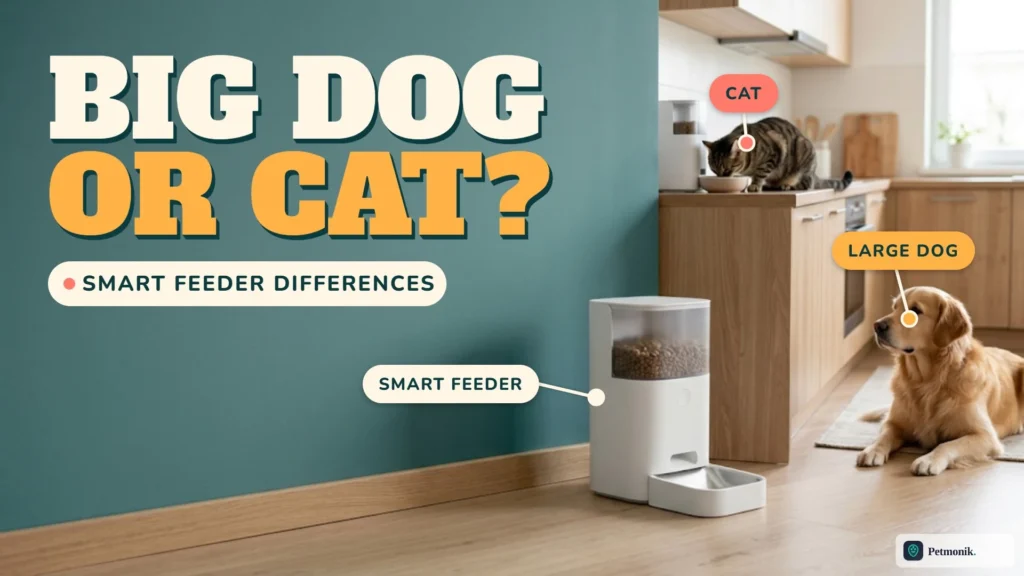
You bought a feeder that worked perfectly for the cat, set it up for the 70-pound Labrador, and by day three the hopper was empty or the kibble was jammed. Dogs are not just bigger cats. Their portions, their kibble and their health risks around mealtime are different, and most smart feeders are designed around cats and small dogs. If you are shopping for a smart feeder for a large breed dog, you need to check capacity, per-meal limits and kibble size before anything else. Below we compare hopper volume requirements, large-kibble chute clearances, and portion pacing to help prevent bloat in deep-chested breeds. In short, choosing a smart feeder large breed dog owners can rely on starts with capacity, not app features.
Quick Summary: Large Breed Dogs vs Cats
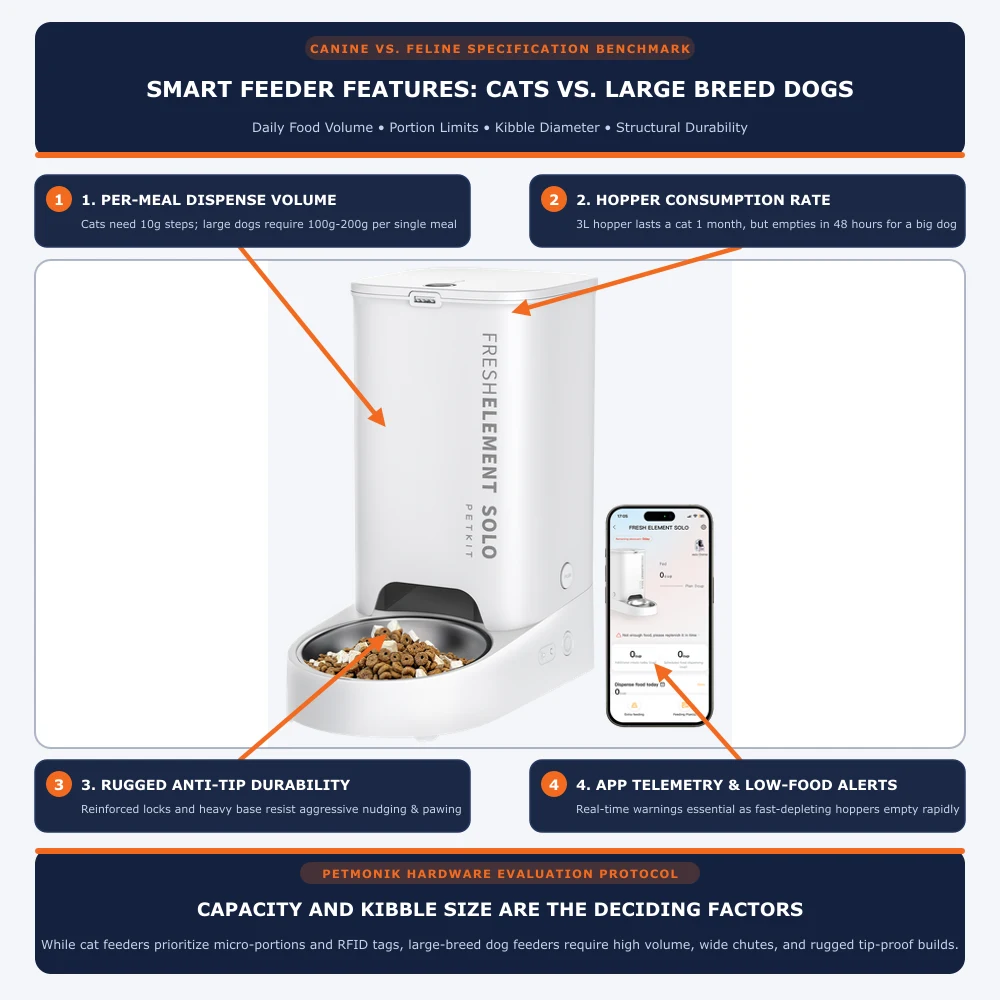
- Capacity runs out fast. A 70-pound dog eating 300 to 400 grams daily empties a typical 3L cat hopper in barely two days; large-breed households need at least 5L to 8L for meaningful multi-day coverage.
- Kibble size can jam feeders. Large-breed formulas often use oversized kibble, and most hopper feeders are built around small-to-medium pieces.
- Petlibro itself says its 5L Granary suits small or medium pets, such as small dogs, cats and rabbits, not larger dogs.
- Feeding schedule matters for health. Cornell lists large single meals and rapid eating as bloat risk factors, and suggests several smaller meals.
How Feeding a Large Dog Differs From Feeding a Cat
| Factor | Cat | Large breed dog |
|---|---|---|
| Daily food volume | Small; a hopper lasts weeks | Large; a small 3L hopper empties in barely two days |
| Per-meal portion | Small portions, 10 g steps are fine | Needs large portions per meal; check the per-meal maximum |
| Kibble size | Usually small | Large-breed kibble can be oversized and jam auger feeders |
| Health risk at mealtime | Overeating and obesity | Bloat (GDV) in deep-chested breeds, plus overeating |
| Wet food | Common | Less common, but most feeders are dry only |
| Multi-pet | RFID bowls are popular | Same, but dogs can force or tip lids; see durability below |
The point is not that smart feeders do not work for dogs. They do, and many are sold for both. It is that the specifications that matter for a cat, such as app features and portion steps, are not the ones that decide whether a large dog is fed properly.
Capacity: How Big a Hopper Does a Large Dog Need?
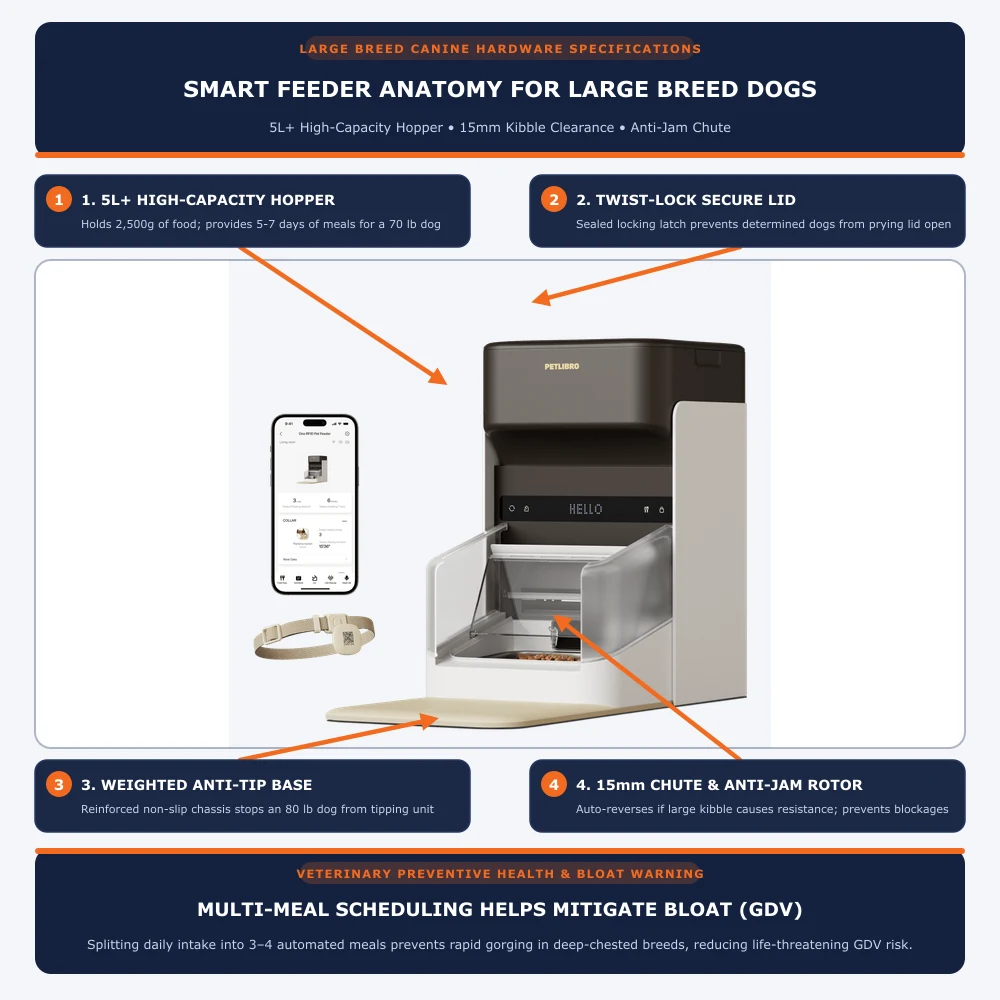
When sizing an automatic feeder for a large dog, aim for at least four to five days of coverage per fill to avoid constant daily refills. Example models for a 70-pound dog include:
| Model | Capacity | Estimated coverage (70 lb dog) | Typical price |
|---|---|---|---|
| Arf Pets Automatic | 18 cups (~4.3 L) | 4 to 5 days | Around $80 to $90 |
| Petlibro Granary Wi-Fi Camera | 5 L (20 cups) | 5 to 6 days | Around $130 to $140 |
| PATPET Wi-Fi Feeder | 3 L (12 cups) | 2 to 3 days (tight for large breeds) | Around $50 to $60 |
Coverage depends on your dog’s exact daily caloric requirements and kibble density; always weigh a daily portion in grams rather than estimating by cup volume.
For a quick check of your own numbers, our feeder capacity guide shows how to turn liters into days of food. On the brands’ own portion data, about 500 g of kibble fits in a liter, so a 5L hopper holds roughly 2,500 g. Weigh your dog’s food to confirm.
Portion Limits and Meal Frequency
Petlibro lists up to 50 portions per meal on its 5L feeders, with each portion about 20 ml or 10 g, roughly 1/12 cup. That is about 500 g in one dispense, so a single meal limit is unlikely to bind for most dogs, but check it on the exact model. PETKIT’s Fresh Element Solo, by comparison, allows 1 to 5 portions per meal, which is only 10 to 50 g and is designed with smaller pets in mind.
There is also a health reason to look at meal frequency. Cornell’s guidance on gastric dilatation-volvulus, or bloat, says large, deep-chested breeds face the highest risk, and lists eating too quickly and feeding once a day or a large volume per meal as risk factors. Its prevention advice includes several smaller daily meals. A scheduled feeder makes that easy to do. It is not a replacement for veterinary advice, so talk to your vet about the right schedule and about preventive options for your breed.
- Bloat is an emergency. Cornell says it needs immediate medical and surgical intervention and is fatal without it.
- Avoid raised bowls unless your vet says otherwise. Cornell lists them as a risk factor and recommends avoiding them.
- Limit exercise after meals, as Cornell advises.
For setting the actual amounts, see our guide to portion control with an automatic feeder, which covers measuring in grams.
Kibble Size: The Spec Most Buyers Miss
Large-breed canine formulas frequently use oversized kibble (15 mm or larger) to encourage chewing, which can easily jam standard rotating-rotor or auger dispensers designed for smaller feline kibble. Petlibro specifies a maximum 15 mm kibble diameter for its 5L Granary, while some wide-chute feeders handle up to 18 mm. Before buying:
- Measure your kibble at its widest point.
- Compare it with the maximum on the spec page, not just the marketing copy.
- Ask support if your kibble is near the limit.
- Keep the anti-jam feature in mind, but do not rely on it. Petlibro describes infrared obstruction detection that stops the feeder when something blocks it.
What to Check Beyond Capacity
Durability and Stability
A strong dog can nudge, chew, or topple a lightweight plastic feeder to get at the hopper. Choose models with twist-lock or latching lids, non-skid rubberized bases, and low centers of gravity, or position the feeder against a wall corner to prevent tipping.
Noise and Nervous Dogs
Some dogs are frightened by feeder motors. Our guide to easing feeder noise fear in a timid dog explains a gradual way to introduce one.
Power Backup
A big dog goes through food fast, so a power cut matters more. See our battery backup guide for published runtimes.
Gravity vs Automatic
If your dog gulps food, a gravity feeder is a poor fit because it cannot limit portions. We compare the two in our gravity feeder vs automatic feeder guide.
Smart Feeder Features: Cats vs Large Dogs
| Feature | Why a cat owner cares | Why a large-dog owner cares |
|---|---|---|
| Hopper size | Weeks of food at small portions | Days, not weeks, so size is critical |
| Portion step | Fine control to prevent obesity | Large dispenses and a high per-meal limit |
| Kibble range | Rarely an issue | Often the deciding spec |
| RFID or multi-pet | Stops food stealing | Stops food stealing, but check lid strength |
| App alerts | Low food, missed meals | Low food, because the hopper empties quickly |
| Battery backup | A few days is plenty | More important with a big eater |
How to Choose: A Buying Checklist
- Work out daily grams from the food label or your vet.
- Divide the hopper by daily grams and aim for four to five days or more of coverage.
- Check the kibble range against your actual kibble.
- Check the per-meal maximum covers your dog’s biggest meal.
- Ask about stability and where you will place it.
- Plan several smaller meals if your vet agrees, especially for deep-chested breeds.
- Think about backup power and a sitter for longer trips.
If you are still deciding whether a smart feeder is right at all, see whether you need an AI pet feeder. For a wider setup with video and a fountain, our feeder, camera and fountain bundle guide covers the options.
The bottom line: picking a smart feeder large breed dog households can trust is mostly a capacity and kibble-size decision, with meal frequency as a health consideration, while a cat’s decision is more about portion control and features. Check the hopper, the per-meal limit and the kibble range first, and take your vet’s advice on how to split your dog’s meals. Prioritize mechanical durability and chute clearance over app novelty when feeding a big dog.
Frequently Asked Questions
What is the best smart feeder for a large breed dog?
Look for high-capacity models like the Petlibro Granary 5L or WOPET 7L series, but always verify that the chute opening accommodates your dog’s specific kibble diameter and that the per-meal portion limit covers their feeding size.
How big should an automatic feeder be for a large dog?
Aim for at least four to five days of coverage per fill (typically 5L or larger for a 70-pound dog eating 300 to 400 grams daily) so you are not refilling the hopper every 48 hours.
Will large-breed kibble fit in a smart feeder?
Not always. Large-breed kibble can be oversized and jam auger feeders. Petlibro lists 2 to 15 mm for its 5L feeder, so measure your kibble.
Can a smart feeder help prevent bloat?
Cornell lists large single meals and fast eating as bloat risk factors and recommends several smaller meals. A scheduled feeder can make that easier, but it is not a prevention method on its own, so ask your vet.
What is the difference between feeding a cat and a large dog with a smart feeder?
Cats need small, precise portions, while large dogs need much bigger hoppers, higher per-meal limits and larger kibble support, plus a meal schedule that considers bloat risk.
Is a gravity feeder okay for a large dog?
Usually not if your dog gulps or overeats, since gravity feeders cannot limit portions. Scheduled meals give you more control.