

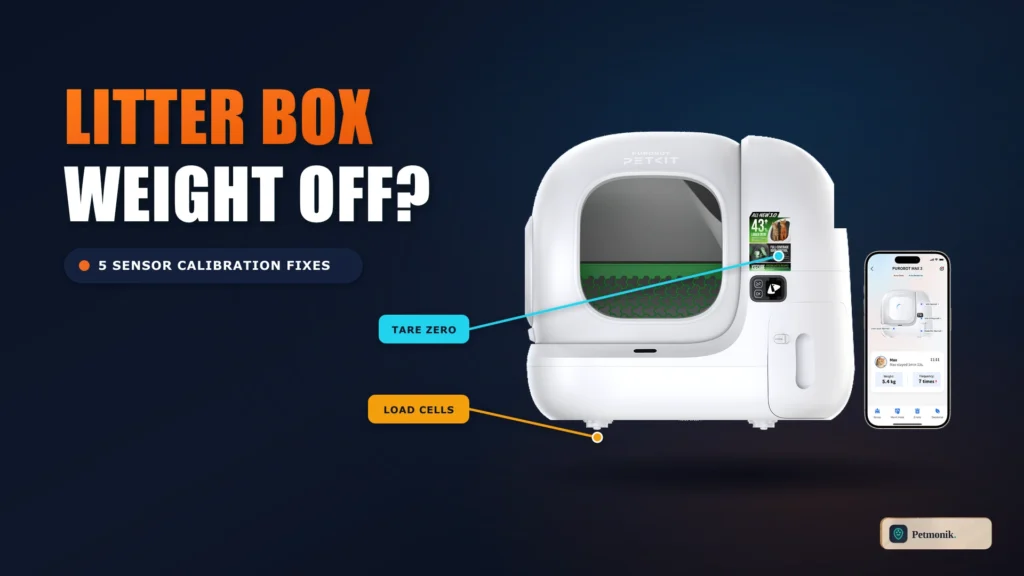
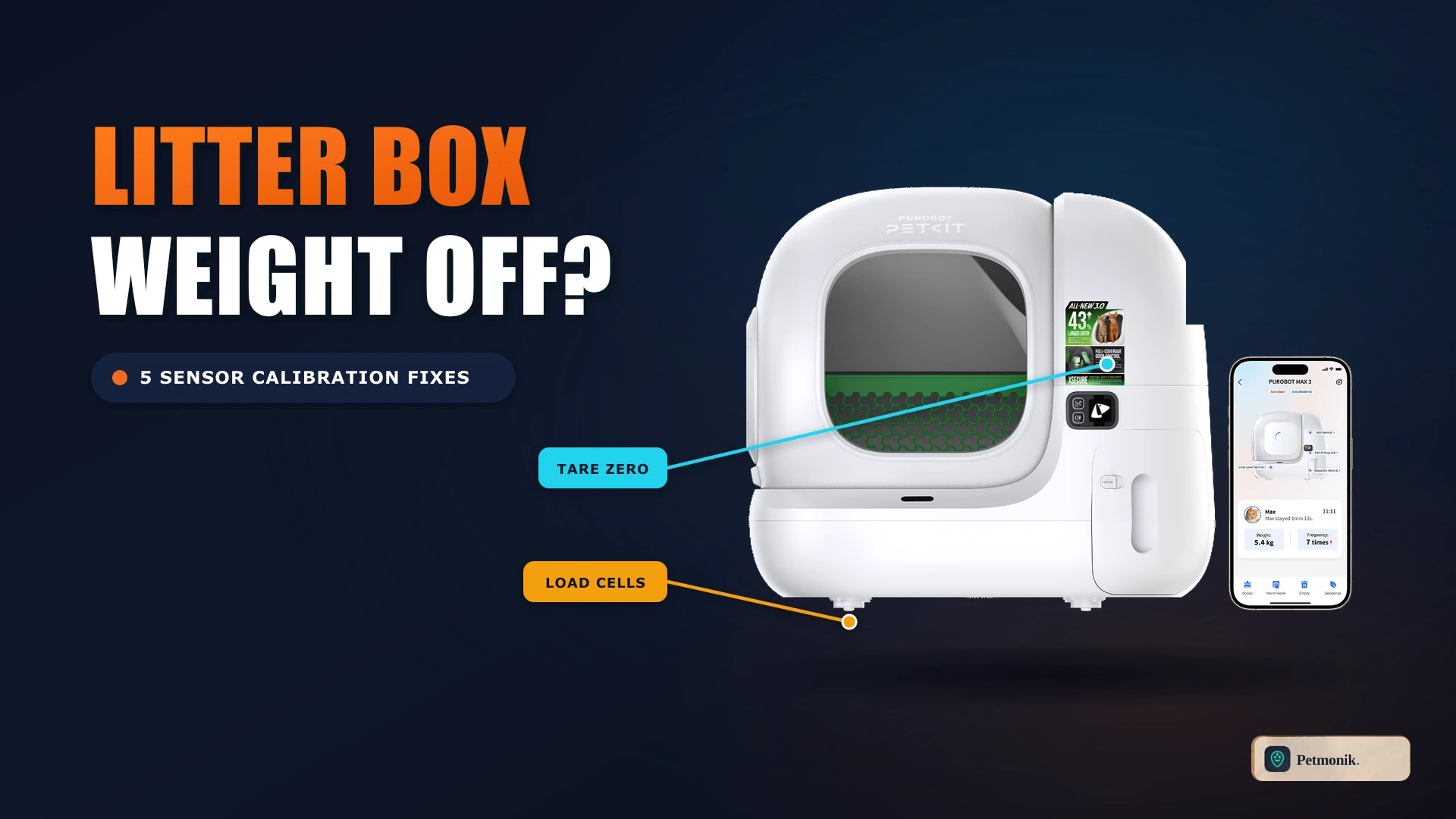
Few features in modern pet technology promise as much peace of mind as the automated weight scale built into smart litter boxes. When functioning correctly, these connected systems track daily waste elimination frequency, flag subtle behavioral deviations, and log feline body weight down to a tenth of an ounce. However, when sensor drift strikes, that high-tech telemetry quickly unravels into phantom cat visits, scrambled health alerts, and false alerts that cause needless panic. Performing a precise smart litter box weight sensor calibration is essential to restoring accuracy across your multi-cat household.
Unlike basic domestic bathroom scales that utilize simple mechanical spring plates, smart litter boxes rely on high-precision strain-gauge load cells integrated directly into the chassis support feet. Even a microscopic mechanical binding against a baseboard or an uneven tile grout line can induce mechanical bias. In this technical guide, we break down the physics of load-cell drift, analyze firmware telemetry glitches, and provide five field-tested calibration steps to guarantee reliable feline weight logs.
Table of Contents
The Engineering Behind Automatic Litter Box Weight Telemetry
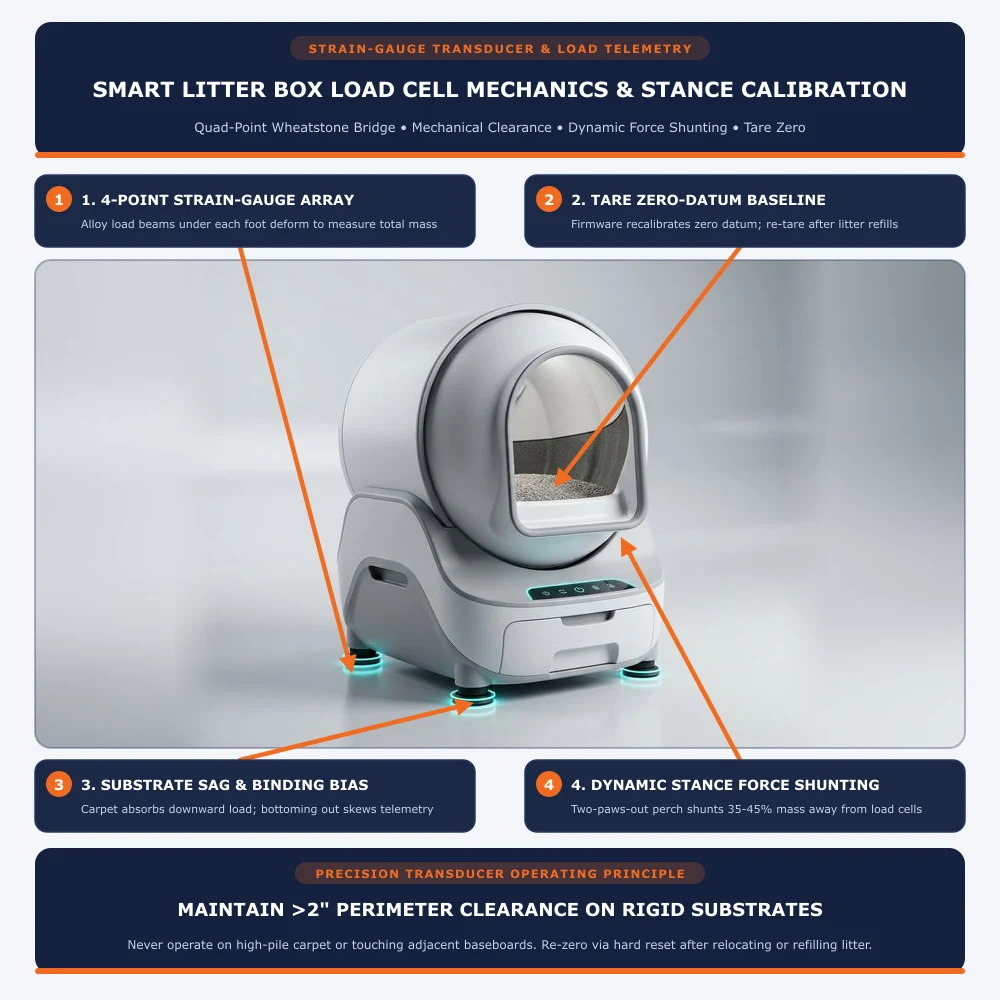
Modern automated self-cleaning litter boxes—including the Whisker Litter-Robot 4, PETKIT Pura Max, and Neakasa M1—rely on a four-point Wheatstone bridge strain-gauge circuit. Underneath each foot of the base frame, an alloy beam deforms microscopic fractions of a millimeter under downward force. As the conductive foil on the beam flexes, its electrical resistance shifts proportionally to the applied load.
An onboard analog-to-digital converter (ADC) samples these microvolt shifts, converting mechanical deflection into digital grams or tenths of a pound. According to transducer calibration standards documented by the National Institute of Standards and Technology (NIST), strain-gauge load cells must operate under strict mechanical isolation to produce repeatable measurements. Any external physical friction, cable tension, or surface incline introduces shear stresses that bypass the sensor beams entirely.
Why Smart Litter Box Weight Sensor Calibration Drifts (Root Causes)
When owners notice weight reporting fluctuating by 1.5 to 3 lbs between consecutive visits, hardware failure is rarely the culprit. Instead, the primary reasons requiring a smart litter box weight sensor calibration stem from ambient mechanical interference:
- Substrate Compliance and Carpet Damping: Placing a 24-pound smart litter box on high-pile carpet or plush rugs allows the undercarriage plastic pan to sag into the carpet pile. When the base pan makes contact with the floor, a percentage of the cat’s downward mass transfers through the shell rather than through the four sensor feet.
- Perimeter Wall Contact: If the unit touches an adjacent drywall, baseboard, or cabinet edge, horizontal shear resistance creates mechanical binding. Even light contact against a power cord wedged under the base disrupts tare zeros.
- Globe Waste Build-Up Bias: Over multiple cleaning cycles, clay dust and residual waste accumulate on the interior walls and beneath the globe drum. If the machine does not perform a successful tare cycle after a rotation, this excess mass is erroneously added to the animal’s weight profile.
- Firmware Tare Zero Latency: Smart boxes log baseline weight immediately after the cleaning cycle completes. If your cat hops back into the globe before the firmware writes the new zero-datum to memory, the telemetry logs corrupt baseline data.
Step-by-Step: 5 Proven Fixes for False Weight Readings
If your pet-tech mobile app is logging erratic fluctuations, execute these five proven steps to re-establish factory-grade measurement precision:
1. Relocate to a Rigid, Level Substrate
Never operate a weight-sensing pet appliance on carpet, linoleum mats, or uneven tile grout lines without a rigid stabilization board. If your only available nook is carpeted, install a 24″ × 24″ rigid 3/4-inch plywood panel or commercial tempered glass platform underneath. Ensure that all four rubberized sensor feet rest completely on the solid platform with at least two inches of perimeter clearance around the outer shell.
2. Inspect and De-Tension All Cables
Examine the low-voltage DC power adapter cable behind the chassis. If the power cord is stretched taut against a wall outlet, it exerts continuous upward or downward mechanical torque on the rear load cell. Provide a 3-inch relaxed service loop in the cord and secure it with a cable clip so that the appliance floats freely on its feet.
3. Perform a Deep Clean and Track Bed Inspection
Fine bentonite clay dust frequently migrates into the lower chassis cavity where the rotation drive gear and sensor harnesses sit. Disassemble the globe drum, vacuum out the base housing, and wipe down the rubber load-cell isolator boots using a damp microfiber cloth. Ensure no stray gravel or compacted litter is wedged between the moving drum and the stationary load-cell mount.
4. Execute the Hard Reset and Firmware Tare Zero
To purge stale tare baselines stored in local EEPROM, follow this standard reset protocol:
- Refill the litter globe to the exact factory max-fill line using fresh litter.
- Power down the unit completely and disconnect the 12V DC power jack for 60 seconds to clear capacitive residual charge.
- Reconnect power and allow the machine to complete its full mechanical homing cycle.
- Once the globe returns to the level home position and the status LED turns solid blue or green, press and hold the Reset / Tare button for five seconds until the unit chimes or flashes.
- Step back completely and keep pets away for three minutes while the onboard ADC samples ambient zero-offset noise.
5. Run a Known-Weight Verification Test
Verify sensor accuracy before reintroducing your cat. Place a calibrated object of known mass—such as an unopened 5.0 lb bag of flour or a verified 10.0 lb dumbbell—directly in the center of the litter bed. Verify that the companion app logs the visit within ±0.2 lbs (±90 grams) of the actual weight. If deviation exceeds 5%, repeat the zero tare sequence on a flatter surface.
How Litter Density and Cat Stance Skew Load Cell Data
Even with pristine sensor calibration, biological variables influence dynamic telemetry readings. Cats exhibit varying defecation postures that dynamically redistribute their weight:
Two-Paws-Out Stance: Many larger cats balance their front paws on the entryway step while keeping their rear paws inside the drum. In models where the entryway step is attached directly to the stationary chassis rather than the floating inner drum, up to 40% of the animal’s weight is shunted away from the primary measurement load cells, generating a reading that appears 3 to 5 lbs lighter than actual body mass.
Litter Material Density Variations: Switching from dense sodium bentonite clay (bulk density ~0.85 g/cm³) to ultra-lightweight tofu, cassava, or pea-husk pellets (~0.45 g/cm³) shifts the center of gravity inside the globe. Always trigger a manual tare reset in your mobile application whenever you switch litter formulas or brands.
Cross-Linking Telemetry: Integrating Litter Data with Feeders and Fountains
In a smart pet ecosystem, a litter box should never operate in isolation. In feline veterinary medicine, sudden weight changes and shifted elimination patterns are early warning markers for chronic kidney disease (CKD), diabetes mellitus, and lower urinary tract issues. According to clinical guidelines from the Cornell Feline Health Center, rapid weight loss combined with increased urination volume demands prompt diagnostic attention.
By pairing your litter box weight logs with data from your feeding and drinking stations, you establish a 360-degree biometric baseline:
- Correlating with Fluid Intake: Cross-reference litter visit frequency with hydration tracking from our guide on tracking cat UTI symptoms early with RFID smart water fountains to differentiate between behavioral straining and true polyuria.
- Calibrating Food Intake: If weight logs show gradual downward drift despite normal activity, verify actual food intake using precision dispensers as outlined in our analysis of portion control automatic feeders for weight management.
- Preventing Feeding Disruptions: Keep your automated ecosystem running reliably by inspecting your dispensers with our troubleshooting guide on automatic pet feeder jamming fixes and rotor maintenance.