

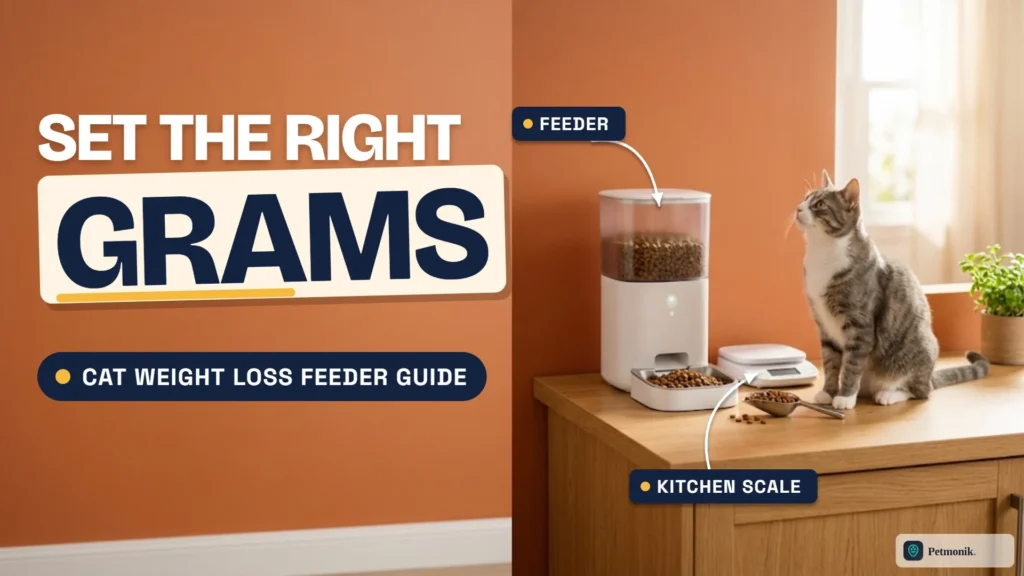
Your vet said your cat needs to lose weight, and now every morning starts at 5 a.m. with a cat screaming at an empty bowl. A scoop of kibble is a guess, a bowl that is topped up all day is a free-for-all, and a few extra kibbles on a small cat add up quickly. A portion control automatic feeder for weight loss takes the guessing out: it serves a fixed amount at fixed times, whether or not you are awake. Below we show how to convert a veterinarian’s daily calorie target into exact feeder grams, calibrate rotor portions on a kitchen scale, and avoid the hidden mistakes that stall weight loss. This portion control automatic feeder weight loss guide shows how to set grams safely.
Quick Summary: Setting Feeder Grams for Cat Weight Loss
- Vet first. A vet should set the target weight and daily calories before any feeder settings change.
- Go slowly. Pet Nutrition Alliance aims for 0.5 to 1% of body weight per week, with 0.5% per week serving as a safe, conservative starting pace.
- Small meals work. Dividing the day’s calories into three to six small meals can help with begging.
- Calibrate. Feeders list portion sizes as approximate, so weigh what yours actually dispenses.
- Never starve a cat. If your cat stops eating for about 48 hours, call your vet.
Table of Contents
Start With Your Vet, Not the Feeder
A feeder is a tool; it cannot decide how much your cat should eat. A vet exam before any programme starts rules out underlying disease, confirms body condition and sets a realistic target weight and daily calorie plan, according to the Association for Pet Obesity Prevention. Pet Nutrition Alliance goes further: for obese pets at body condition score 7 out of 9 or higher, it advises a weight-loss programme under the direct guidance of the veterinary team.
Expect it to take a while. The Association for Pet Obesity Prevention gives a planning range of about 2 to 5% of body weight per month for cats, and says a fixed six- or twelve-month timeline does not fit every cat. How long it takes depends on how much weight your cat has to lose and the rate your vet judges safe. Your vet may also choose a therapeutic weight-loss food rather than just feeding less of the usual food, because it is formulated to reduce calories while still covering nutrition. Follow their choice, and use the feeder to deliver it.
How to Convert Calories Into Grams
Your vet gives you a daily calorie target. The feeder works in portions, so you need grams. The pet food label lists calories per kilogram or per cup; your vet can help with the exact figure for your food. The arithmetic is simple:
- Grams per day = daily calories divided by calories per gram of your food.
- Grams per meal = grams per day divided by the number of meals.
Here is a purely illustrative example, not a recommendation for your cat. If a vet sets 200 calories a day and the food has 4 calories per gram, that is 50 grams a day. The table shows how that could be split, and why the number of meals matters when a feeder serves in fixed steps.
| Meals per day | Grams per meal (example: 50 g/day) | Fits a 10 g portion step? |
|---|---|---|
| 3 meals | About 16.7 g | No: 1 portion is 10 g, 2 portions is 20 g |
| 4 meals | 12.5 g | No: between 10 g and 20 g |
| 5 meals | 10 g | Yes: 1 portion each |
| 2 meals | 25 g | No: between 20 g and 30 g |
Illustrative numbers only. Your vet sets the real target, and your food’s calorie density will differ.
Portion Control Automatic Feeder Weight Loss: What the Specs Say
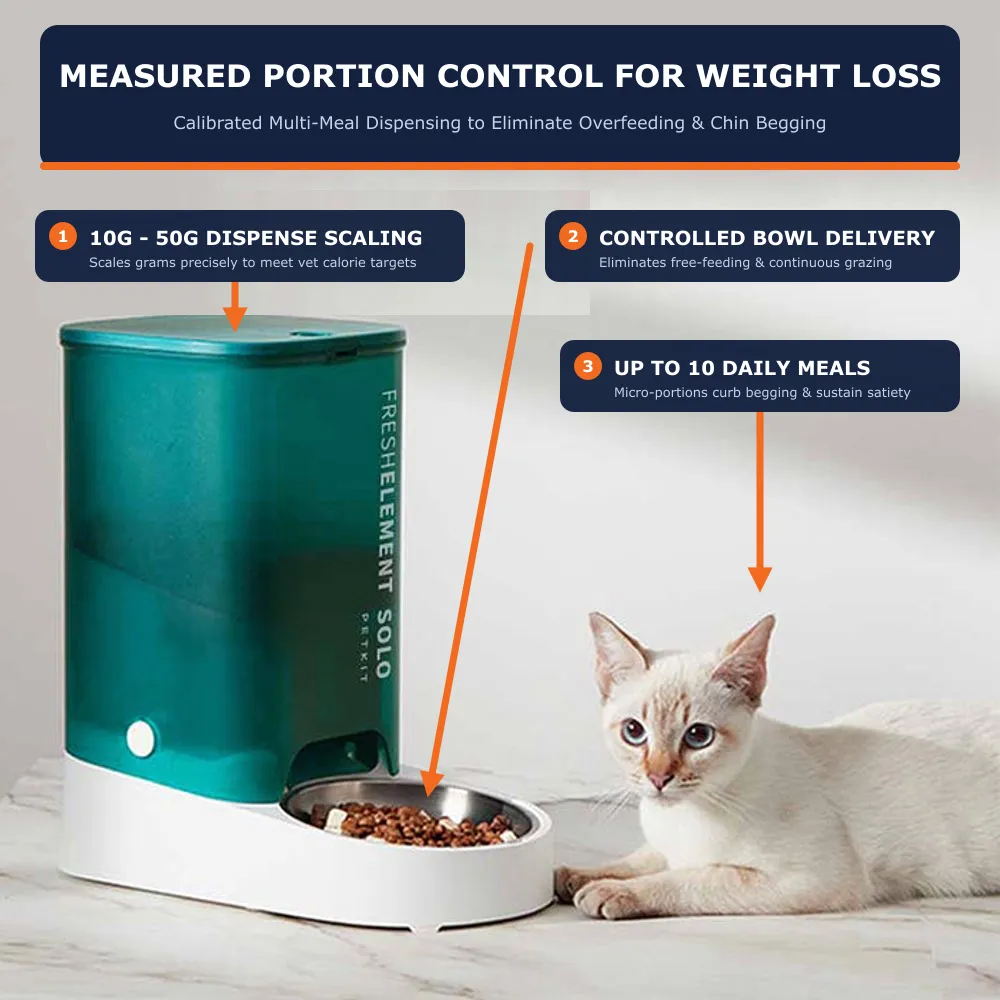
Not every feeder offers the same control. Petlibro lists its Granary as serving about 20 ml or 10 g per portion (roughly one twelfth of a cup), with up to 50 portions per meal. PETKIT’s YumShare Dual-hopper 2 dispenses 1 to 10 portions per meal from each hopper (typically around 10 g per portion depending on kibble density), which is why kitchen-scale calibration matters.
| Petlibro Granary WiFi | PETKIT YumShare Dual-hopper 2 | |
|---|---|---|
| Portion size listed | About 10 g (about 20 ml) | ~10 g per portion (varies by kibble size; weigh to confirm) |
| Portions per meal | Up to 50 | 1 to 10 per hopper |
| Hopper capacity | 5 L | 5 L total across two hoppers |
| Power backup | Dual power with battery backup | Dual power supply |
| Listed price | $89.99 | $152.98 (sale price) |
Comparison of smart feeder portion-step controls. Retail pricing varies with seasonal promotions.
The takeaway is not which feeder wins; it is that portion size is approximate. Kibble shape and density change the weight of a portion, so confirm it on a scale. For a wider look at which features are worth paying for, see our guide to AI pet feeder features worth paying for.
How to Set Feeder Grams for Cat Weight Loss, Step by Step
Step 1: Get Your Vet’s Daily Calorie Target
Ask for the daily calories, the exact food to use, and how often to weigh your cat. Write down the target in grams per day once you know the food’s calorie density.
Step 2: Calibrate the Feeder With a Kitchen Scale
- Fill the hopper with the food your cat will actually eat.
- Run a manual feed of a few portions into a bowl and weigh it.
- Divide by the number of portions to find the real grams per portion.
- Repeat once or twice and average the results.
Step 3: Choose the Number of Meals
Pick a meal count that your portion step can hit. Feline nutritionists commonly recommend three to six small meals per day to improve satiety and curb morning begging. Use the table above to see which counts fit your feeder.
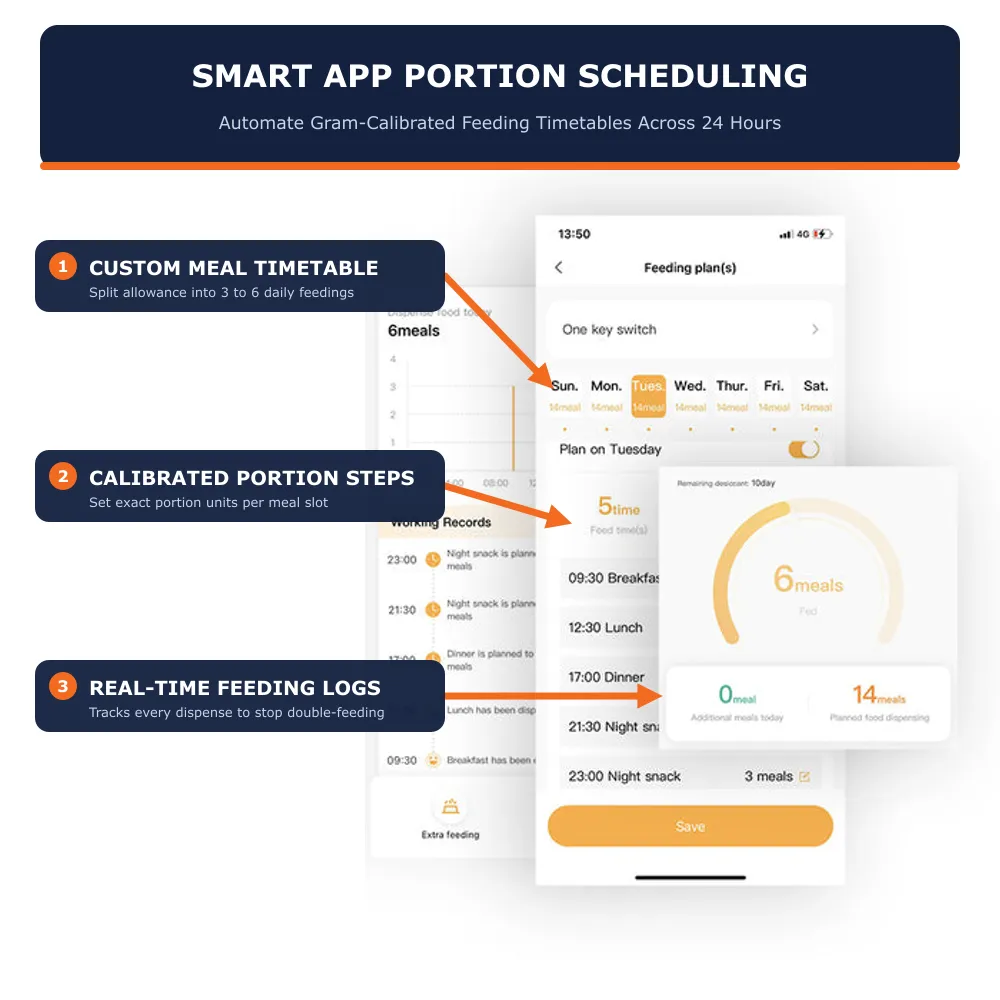
Step 4: Program the Schedule
- Open the feeder app and set each meal time.
- Enter the number of portions per meal so the total matches your daily grams.
- Spread meals across the day, including one near bedtime if your vet agrees.
- Turn on low-food and jam alerts so a missed meal never goes unnoticed.
Step 5: Weigh In and Adjust With Your Vet
Weigh your cat on a set schedule and record it. If weight is not moving, or it is dropping faster than your vet planned, call them before changing portions yourself.
Treats, Multi-Cat Homes and Other Hidden Calories
- Count treats. Pet Nutrition Alliance says treats should stay under 10% of daily calories, and the Association for Pet Obesity Prevention suggests low-calorie options such as lean fish, egg or poultry.
- Avoid free-feeding. The Association for Pet Obesity Prevention says gravity feeders, community bowls and repeatedly topping up a bowl make intake difficult to measure, which is the opposite of what a weight-loss plan needs.
- Watch other pets. If a second cat can reach the bowl, your plan falls apart. See our guides on stopping cats stealing each other’s food and smart feeders for multiple cats on prescription diets.
- Introduce the feeder gently. A nervous cat may need time; our guide to moving a scared cat to an automatic feeder explains how.
Warning Signs: When to Call the Vet
Rapid calorie restriction is dangerous in cats. The Association for Pet Obesity Prevention says a cat that has eaten little or nothing for 24 hours needs veterinary assessment the same day, and that reduced intake and rapid weight loss can raise the risk of hepatic lipidosis, a serious liver condition. If your cat eats little or nothing for 24 hours, or is losing weight faster than planned, contact your vet immediately rather than adjusting the feeder yourself.
The bottom line: a feeder cannot choose your cat’s calories, but it can deliver them exactly. Get the target from your vet, convert it to grams, calibrate the feeder on a scale, and weigh your cat regularly. Petmonik will update this guide as feeders change; if your model lists portion sizes differently, tell us through our contact page. This guide is general information, not veterinary advice.
Frequently Asked Questions
How many grams should I set on an automatic feeder for cat weight loss?
Your vet decides the daily calories, and the grams depend on your food’s calorie density. Divide daily calories by calories per gram, then divide by the number of meals. Check the feeder’s real portion weight on a scale before you rely on the setting.
How fast should a cat lose weight?
Pet Nutrition Alliance aims for 0.5 to 1% of body weight per week, with 0.5% per week serving as a conservative starting pace. Many cats take 6 to 12 months, and your vet should guide the pace.
How many meals a day is best for a cat on a diet?
Dividing daily calories into three to six small scheduled meals helps maintain satiety and reduce begging between feedings. Choose a meal count your feeder’s portion size can hit accurately.
Are automatic feeders accurate enough for weight loss?
Feeders list portion sizes as approximate. For example, Petlibro lists about 10 g per portion for the Granary. Kibble shape affects the weight, so calibrate by weighing what the feeder dispenses.
What if my cat stops eating on a weight-loss plan?
Call your vet. The Association for Pet Obesity Prevention warns that a cat that does not eat for two to three days can develop a life-threatening liver disease, and advises seeking help if there is no eating for 48 hours.