Buy the Petlibro One RFID if you need to stop a cat from stealing food — its lid opens only for the paired collar tag, so a thief physically can’t reach the bowl. Buy the PETKIT YumShare Dual-hopper 2 if you need to know who eats what across several cats — it identifies each cat with an AI camera and logs every meal, but any cat can still eat from it. In a multi-cat home, food stealing usually follows the same pattern: one cat eats fast, then clears a second bowl while the slower or shyer cat backs away, and when one of them is on a prescription or weight-loss diet, that stops being a nuisance and starts undermining treatment. Below, we evaluate the YumShare Dual-hopper 2 against the Petlibro One RFID across physical access control, multi-cat recognition accuracy, app ecosystems, and real-world household setups.
PETKIT YumShare vs Petlibro One RFID: Quick Verdict
If you need to stop a cat stealing food, buy the Petlibro One RFID: its lid opens only for the paired tag, so a thief physically can’t reach the bowl. If you need to know who eats what across several cats, buy the PETKIT YumShare Dual-hopper 2: it identifies each cat and logs every meal, but any cat can still eat from it.
Petlibro app: up to 10 meals a day, feeding logs, lid mode and closing speed
Camera
Yes; video replay needs Care+ (better)
No
Backup power
4 D batteries (not included)
3 D batteries (not included); WiFi off on battery
Warranty
2 years (bought from Jan 1, 2025)
24 months
Recognition Technology Compared
RFID: a lock with one key
The One RFID reads a small collar tag and opens its lid only when that tag is close to the reader. It doesn’t read implanted microchips, and each feeder pairs with a single tag, so every cat whose food you want to protect needs its own feeder. The strength of this design is that it enforces the rule: a cat without the tag gets a closed lid.
Owner reports and reviews point to where it falls short in real homes:
Recognition itself is reliable. Cats.com’s reviewer found the tag consistently opened the feeder for the tagged cat and kept others out, and Best Buy owners rate it 4.5 out of 5 across 14 reviews, with one saying it stops a food-motivated cat eating the other pets’ meals.
The closing lid is the weak point. Customers quoted in the Cats.com review describe the lid taking 7 to 9 seconds to close even at the fastest setting, which gives a waiting thief a window to reach in.
Tags go missing. The breakaway collar is a safety feature, but it means the tag can come off. One Best Buy reviewer’s cat lost the tag within a day.
Determined cats try force. Cats.com notes owner reports of cats breaking into the unit, and one Best Buy reviewer said a plastic lid part broke.
Placement matters too. In our Petlibro RFID setup guide we cover Petlibro’s advice: keep the tag hanging under the chin, keep metal objects away and space RFID feeders at least 25 cm apart.
AI camera: a witness, not a gatekeeper
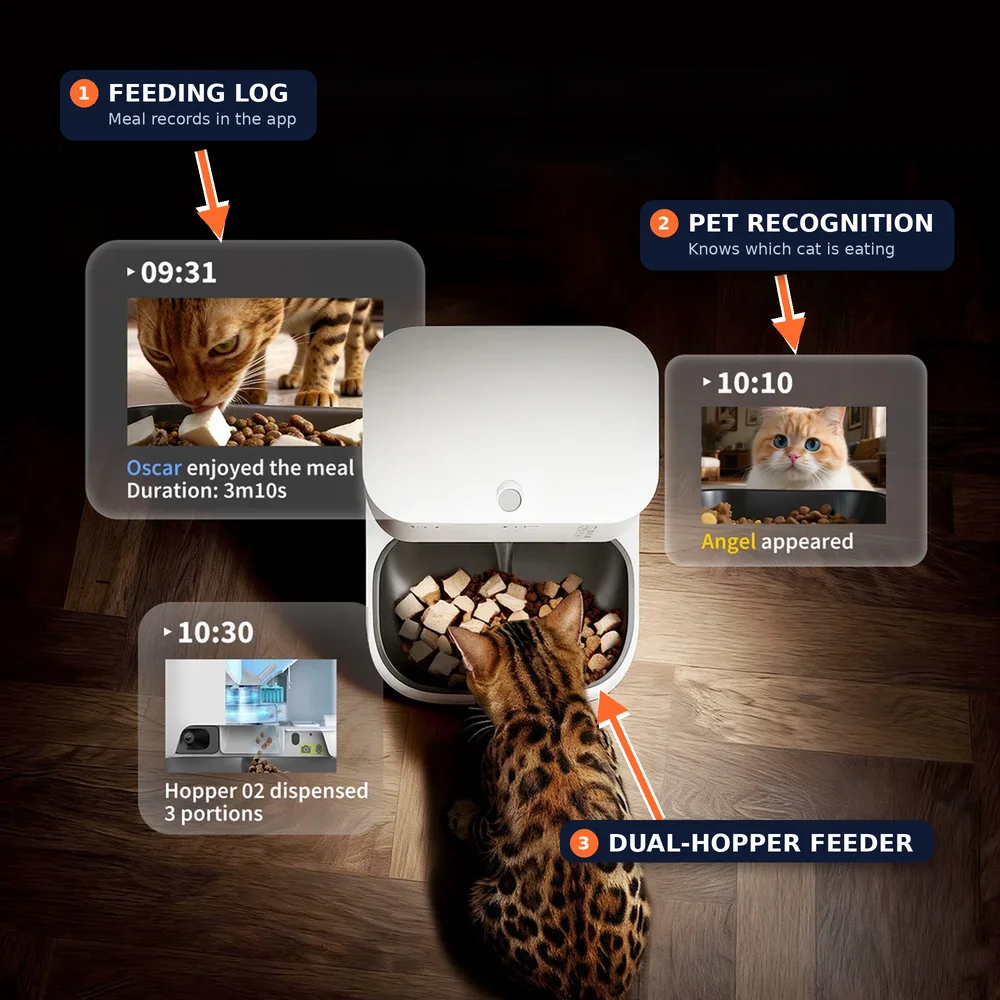
The YumShare Dual-hopper 2 uses facial recognition to tell apart up to 15 pets, with no collars involved, and logs each visit alongside before-and-after photos of the bowl. It has no lid or access control, so it can’t stop a cat eating. It records the theft rather than preventing it.
Because computer-vision recognition relies on clear camera framing, ambient lighting, viewing angles, and overlapping visits can occasionally affect coat-and-face matching—and two cats crowding one bowl at once is the exact scenario where food stealing happens. While early owner ratings on PETKIT’s store average 4.76 out of 5, treat the automated meal logs as a directional trend and verify the captured bowl photos whenever a visit looks unusual.
That doesn’t make the camera useless in a food-stealing home. If you don’t yet know which cat is the thief, or when it strikes, a couple of weeks of PETKIT logs will tell you, and the before-and-after photos show whether a prescription meal was finished by the right cat. You can use that evidence to decide which cat actually needs a selective feeder.
Source: PETKIT
App Experience & Reliability
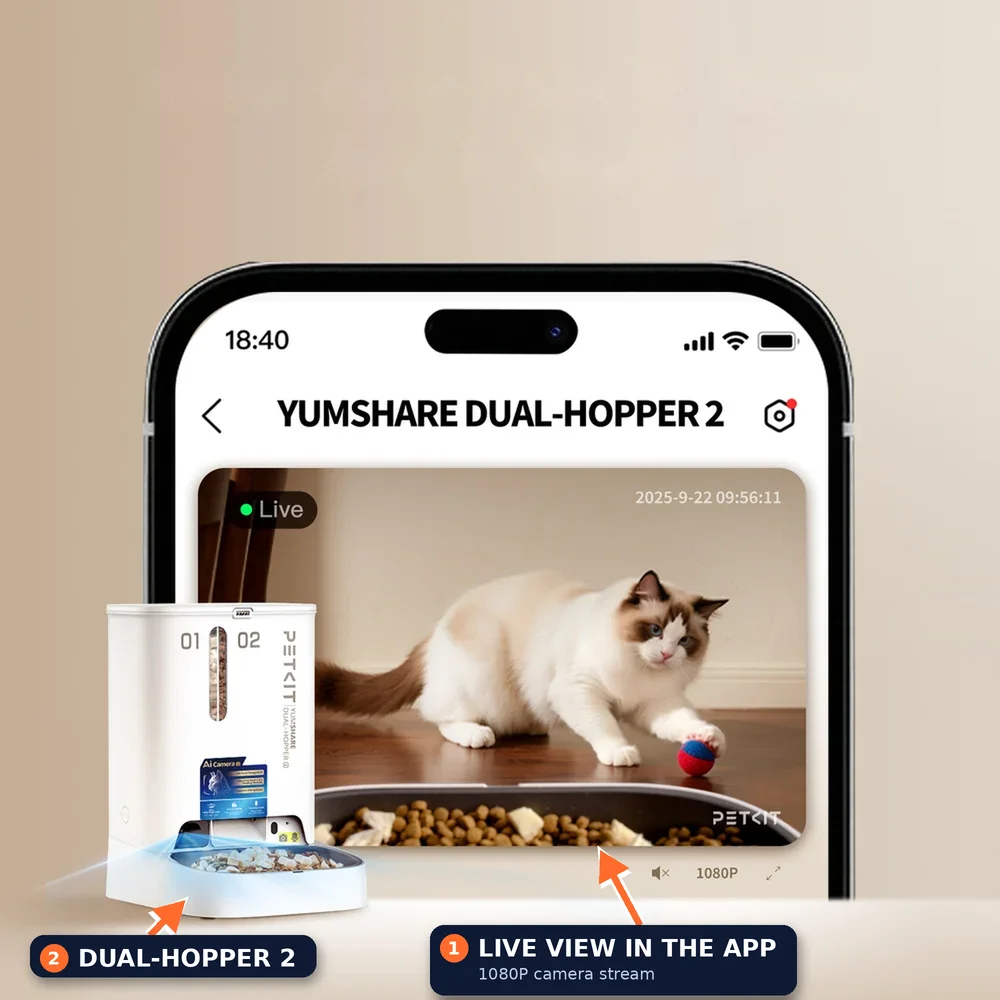
PETKIT offers the richer app: live video, per-cat meal records, bowl photos and schedules for each hopper, all in the same PETKIT app as its fountains and litter boxes. The catch is cost. Video replay needs a PETKIT Care+ subscription once the trial ends. Reliability isn’t flawless either: on PETKIT’s community forum, owners of the original YumShare Dual-hopper report a “System error. Feeder stopped.” message, with scheduled meals failing while manual feeding still works. Our PETKIT not-dispensing guide covers the fixes.
Whichever brand you land on, you’ll eventually need to deal with the desiccant packet inside — see our guide on how often to replace it.
Petlibro’s app is simpler because the feeder does less. Cats.com’s reviewer found it easy to navigate, with up to 10 meals a day, portions as small as 1/12 cup, a feed-now button and settings for lid mode and closing speed. The trade-off is that there’s no camera, so you only learn what a thief did from the feeding log, not from footage. One practical note: Petlibro says WiFi and reset don’t work on battery backup, so during a power cut the feeder keeps to its schedule but drops out of the app.
Source: PETKIT
Setup Difficulty
PETKIT is quicker on day one. You add the feeder in the app, connect it to WiFi and create a profile for each cat. Nobody wears anything, and one feeder covers the whole household. The work is ongoing instead: checking that recognition is labelling each cat correctly, keeping the hoppers sealed and dry, and keeping kibble within PETKIT’s size limits.
Petlibro takes more effort up front. You seat the base, pair the feeder over Bluetooth, register the tag, fit the collar and then train your cat. The app lets you keep the lid open, and we recommend doing that for the first few days so a wary cat gets used to the feeder before you switch to tag-only access. It’s the cat, not the app, that sets the pace, and a nervous eater may need a week or more. Budget for a feeder per protected cat, and for spare tags.
Check your food before buying either one. The One RFID takes dry kibble between 2 and 15 mm; PETKIT lists dry kibble up to 12 mm and freeze-dried pieces up to 9 mm. Neither handles wet food, and oversized or oddly shaped kibble can jam either one.
Which One to Buy
Two-cat home
If one cat steals and both eat the same food, the question is whether you need to stop it or just track it. To stop it, give the victim a One RFID so its meals are protected. For full separation, where neither cat can eat the other’s food, you need two One RFID feeders, one tag each. If the stealing is occasional and you mostly want to know who ate what, one YumShare Dual-hopper 2 covers both cats for less than two Petlibros.
Prescription diet home
Buy the Petlibro One RFID for the cat on the diet. A therapeutic diet only works if the patient eats it and the others don’t, and only a lid enforces that. Two limits apply: the One RFID handles dry kibble only, so a wet prescription diet needs a different feeder, and the diet cat can still raid an open bowl, so feed the others at set times in another room. Keep your vet in the loop on any change.
Budget-conscious
The One RFID costs less at list price ($149.99 against $169.99), and it has no video features to subscribe to. For one cat that needs protecting, it’s the better value. The maths changes with more cats: protecting three cats means three Petlibros, while one PETKIT monitors up to 15, but it protects none of them.
The bottom line: for the problem in the title, multi-cat food stealing, the Petlibro One RFID is the one that solves it, because it’s the only one of the two that physically keeps a thief out. The PETKIT YumShare Dual-hopper 2 is the better monitoring tool, and a sensible second purchase if you want the data. Petmonik will update this comparison as we gather more owner reports; if you run either feeder in a multi-cat home, tell us how it’s going through our contact page.
Which is better for multi-cat food stealing, the PETKIT YumShare or the Petlibro One RFID?
For stopping a thief, the Petlibro One RFID, because its lid opens only for the paired collar tag. The PETKIT YumShare Dual-hopper 2 is the better monitoring tool: it identifies each cat and logs every meal, but any cat can still eat from it.
Does the PETKIT YumShare Dual-hopper 2 stop other cats from eating?
No. It uses AI facial recognition to tell apart up to 15 pets without collars and logs each visit with before-and-after bowl photos, but it has no lid or access control. It records the theft rather than preventing it, and independent accuracy testing is thin.
Does the Petlibro One RFID work with microchips or more than one cat?
No. It reads only its own RFID collar tag, not implanted microchips, and each feeder pairs with a single tag. Every cat whose food you want to protect needs its own feeder, so full separation between two cats takes two One RFID feeders.
What are the weak points of the Petlibro One RFID?
Tag recognition itself is reliable in the reviews we read, but owners report a lid that can take 7 to 9 seconds to close even at the fastest setting, which gives a waiting thief a window. Breakaway collar tags can also come off, and some cats try to force the unit.
What food do the PETKIT YumShare Dual-hopper 2 and Petlibro One RFID accept?
Only dry food. The One RFID takes dry kibble between 2 and 15 mm. The YumShare Dual-hopper 2 takes dry kibble up to 12 mm and freeze-dried pieces up to 9 mm. Neither handles wet food, and oversized or oddly shaped kibble can jam either one.
Verdict
Our pick: Petlibro One RFID
For multi-cat food stealing, the Petlibro One RFID is our pick: its tag-activated lid is the only one of the two that physically keeps a thief away from a protected cat's food. Choose the PETKIT YumShare Dual-hopper 2 if you mainly want to see who eats what across several cats. It identifies and logs each cat, but it doesn't block any of them.
Sam Kerrow is the lead editor and smart pet technology researcher at Petmonik. Focusing on multi-pet households, RFID and AI selective feeders, smart hydration fountains, and pet telemetry data, Sam tests device reliability, firmware behavior, and practical troubleshooting for cat and dog owners.