

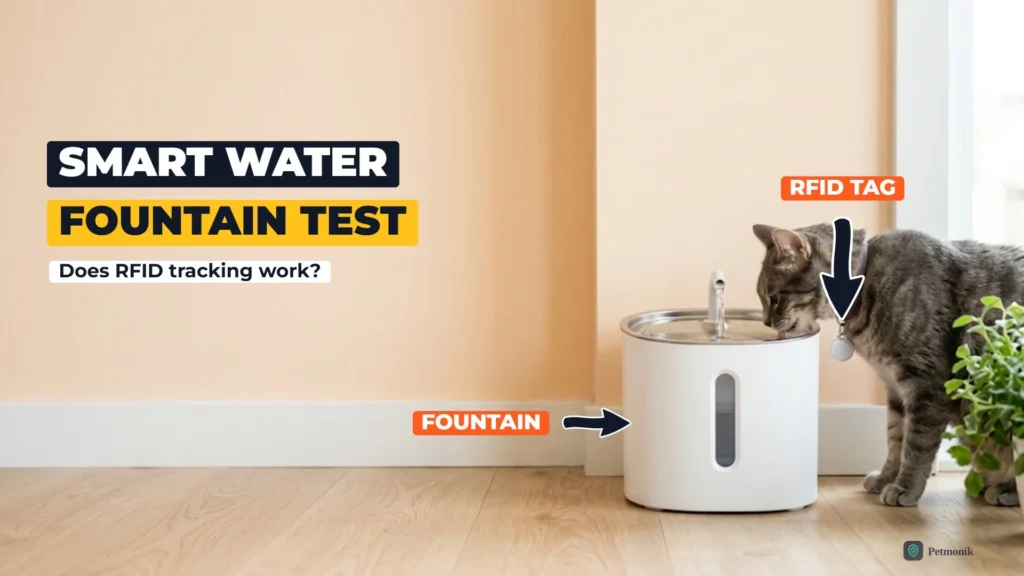
RFID water fountains do track which cat drank what — but accuracy and reporting vary enough between brands that the numbers deserve some scrutiny, which is what we dig into below. In a multi-cat home, a shared fountain only tells you how much water the household drank, not which cat drank it, so a cat with kidney disease can double its intake and the change disappears into the total. Water intake is one of the earliest signs something is changing in a cat’s health — PetMD notes declining kidney function is the most common reason older cats start drinking more, with a healthy cat needing roughly 4 ounces of water per 5 pounds of body weight a day.
Table of Contents
How Smart Water Fountain RFID Cat Hydration Tracking Works
An RFID fountain has two jobs: identify who is drinking, and measure what they drank.
Identification comes from a small tag on each cat’s collar. When the tag comes within range of a reader near the drinking area, the fountain opens a session for that cat. It doesn’t read implanted microchips, so every cat you want tracked needs to wear a tag.
Measurement is the harder part. Petlibro says the Dockstream RFID records the volume, frequency and duration of each cat’s drinking sessions, but it doesn’t publish exactly how it calculates volume. In general, a fountain can only see water leaving the system during a tagged session and attribute that loss to the cat whose tag it read. It can’t tell drinking from splashing or evaporation, or from a second, untagged cat drinking at the same time.
That gives three practical rules:
- Frequency and duration are the most reliable data. They depend only on the tag being read.
- Volume is an estimate. It is useful for trends, not exact measurements.
- Untagged cats are invisible, and so is any cat whose tag hangs out of the reader’s range.
Petlibro Dockstream RFID — In-Depth Look
The Dockstream RFID is Petlibro’s multi-cat version of its Dockstream fountain, launched in September 2024. It holds 3 L, has a stainless steel drinking tray and comes with two RFID collar tags. It can track up to five cats, with extra tags sold separately. Petlibro rates it at under 23 dB, and it connects over 2.4 GHz WiFi only, so a 5 GHz-only network won’t work.
Our verdict
Petlibro Dockstream RFID Smart Fountain
Pros
- RFID per-cat tracking
- Quiet pump (under 23 dB, per Petlibro)
- App daily logs
Cons
- Occasional WiFi drop-outs reported by owners
- App occasionally drops data
Best for
- Multi-cat homes
- Cats under vet monitoring
Key specs
| Capacity | 3 L |
|---|---|
| Connectivity | WiFi 2.4 GHz only |
| RFID | Yes (2 tags included, up to 5 cats) |
| Filter replacement | Every 2 weeks (per Petlibro) |
| Warranty | 24 months |
Each tag pairs with one cat’s profile in the app. The tags clip to a snap-release collar and carry a QR code with your contact details, so a lost tag can be returned.
In the Petlibro app, each tagged cat gets its own hydration profile with timestamps, and the app sends alerts for low water and irregular drinking. It shares the app with Petlibro’s feeders, which is convenient if you already run a Petlibro RFID feeder.
Owner feedback is mixed on the feature that matters most. Chewy owners rate it 3.5 out of 5 across 35 ratings. They praise the quiet running, easy cleaning and sturdy build, but report inconsistent tracking, especially with long-haired cats, and some see little or no data despite visible drinking. Other complaints include leaks over time, a water-level sensor that misreads, confusing setup instructions and WiFi drop-outs. Best Buy’s handful of owner reviews is more positive, at 4.5 out of 5 from eight reviews, but that is a small sample.
One maintenance note: Petlibro’s product page recommends replacing the filter every two weeks, more often than most fountains, so budget for filters.
PETKIT Eversweet Series — How It Compares
PETKIT takes two different routes, and only one of them tracks individual cats (see our PETKIT YumShare vs Petlibro One RFID comparison for the feeder side of this).
If you’re also running a wet food feeder, moisture control matters there just as much — see our breakdown of wet food automatic feeder safety.
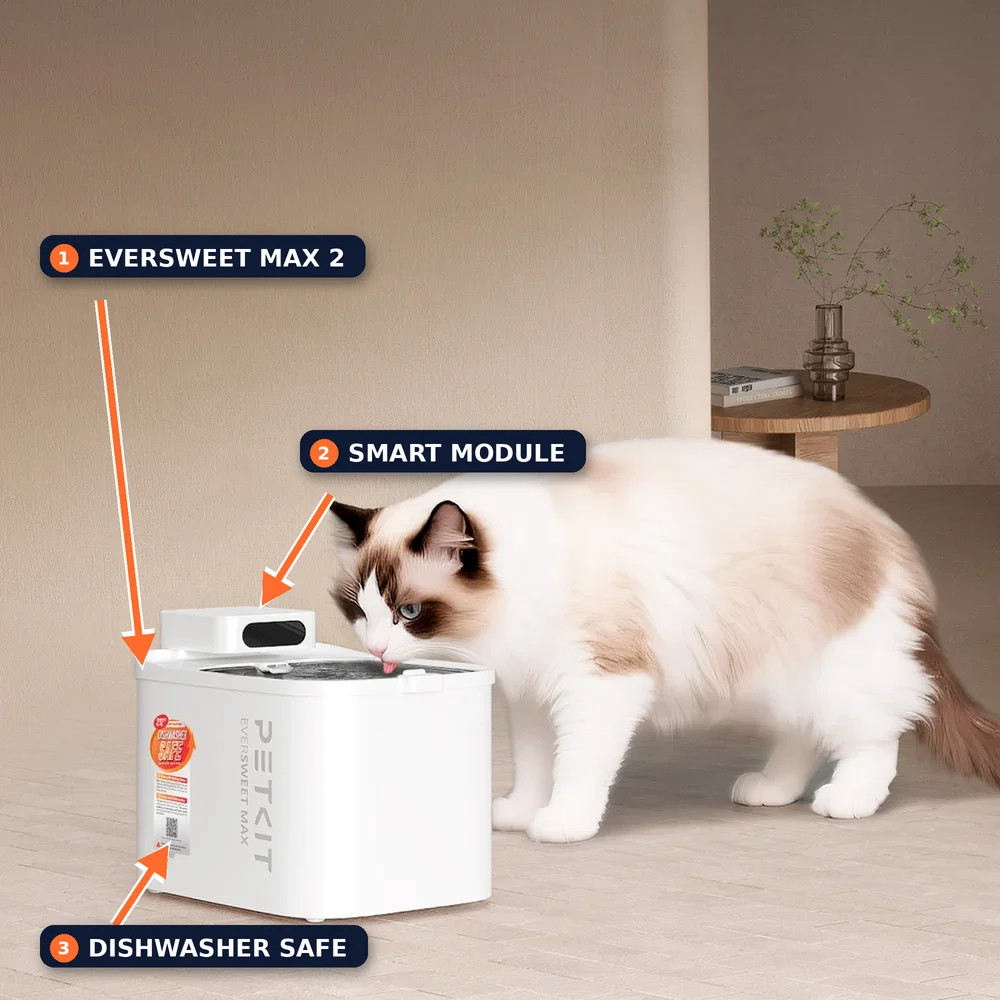
- EverSweet Max 2 (UVC), $99.99. A 3 L cordless fountain that PETKIT says runs up to 83 days on a charge, with a UVC pump. It logs daily, weekly and monthly drinking frequency and duration, but for the fountain as a whole, not per cat. It connects over Bluetooth and needs another PETKIT device as a hub for remote access.
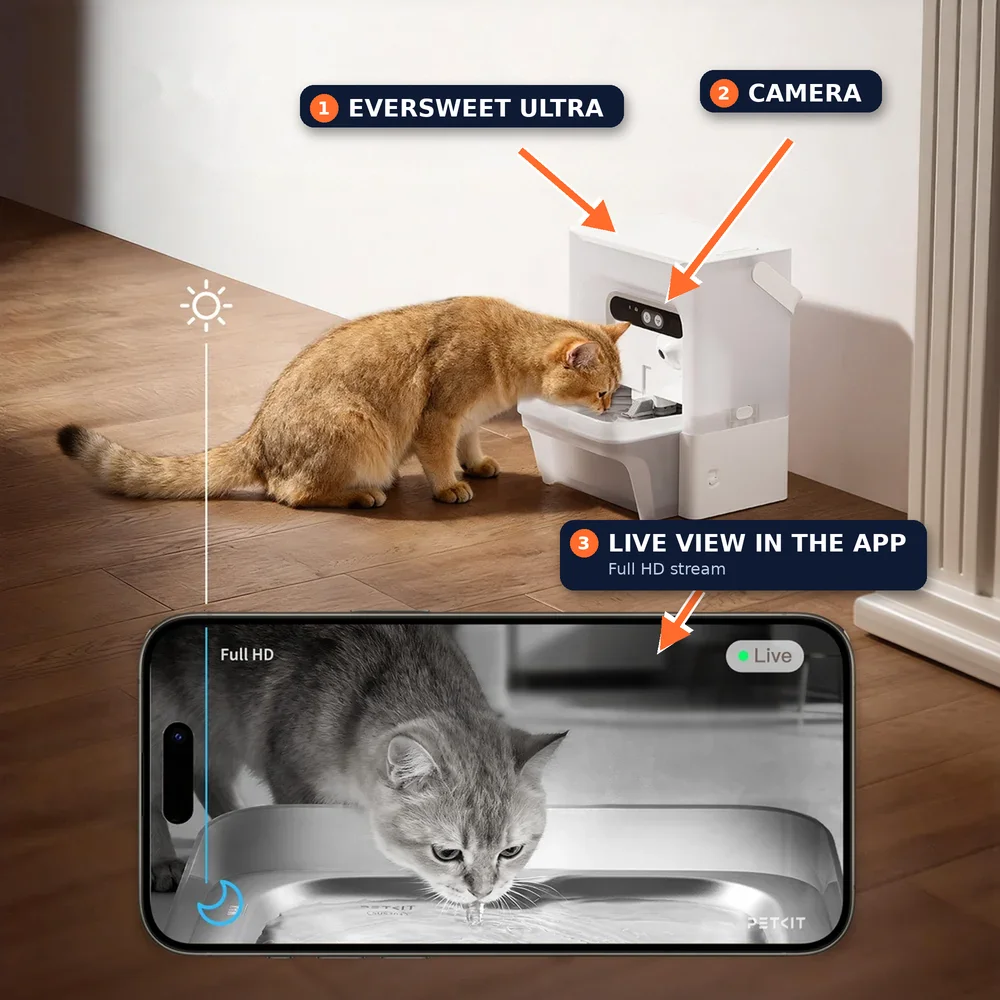
- EverSweet Ultra, $249.99. PETKIT’s multi-pet model skips tags altogether. A 140-degree camera identifies up to 15 pets, and PETKIT says the app records when each pet arrived, how long it stayed and how much it drank. It uses a one-way flow design that sends used water to a separate waste tank, so there’s no filter to replace. PETKIT lists pet recognition among its Care+ features, so check what’s included without a plan before you buy.
Against the Dockstream RFID, the EverSweet Ultra removes the collar tag, the most common point of failure, but costs about two and a half times as much and adds a camera. As with any optical recognition system, ambient lighting, drinking angles, similar-looking coats, and bowl crowding can affect camera identification, meaning daily volume logs are best interpreted as a multi-day trend.
Is Per-Cat Hydration Tracking Actually Accurate?
In multi-cat clinical monitoring, smart fountain telemetry is accurate enough to spot a meaningful hydration trend, though not to measure an exact clinical dose.
- Identification works when the tag is read. The most consistent owner complaint is missed sessions, not misattributed ones. Long fur, a tag that twists to the back of the neck or a cat that drinks from an angle can all leave a visit unrecorded.
- Volume numbers drift. Evaporation, splashing and two cats drinking together all end up in the numbers. A single day’s reading can be meaningfully off.
- Trends hold up better. If a cat’s sessions double over two weeks, that change is real even if each measurement is rough.
- Food matters. Cats on wet food get much of their water from meals, so a low fountain reading doesn’t necessarily mean a cat is dehydrated.
You can make the data more reliable:
- Check each tag daily, and make sure it hangs under the chin rather than at the back of the neck.
- Make the fountain the main water source while you’re collecting a baseline, so intake isn’t split across bowls.
- Compare weekly averages, not single days, and note when a cat’s diet changes between wet and dry food.
- Keep the fountain topped up and clean on a steady schedule, so refills and cleaning don’t distort the readings.
If your vet needs a precise figure, the reliable method is still the one PetMD describes: a single bowl, a measuring cup and a 24-hour check. Use the fountain to decide when that check is worth doing.
Who Should Buy an RFID Water Fountain
Buy one if:
- You have two to five cats and one is older, has kidney disease, diabetes or hyperthyroidism, or is otherwise being monitored by your vet.
- Your cats will wear a breakaway collar with a tag.
- You’ll check the app regularly and act on the trends, not single readings.
Skip it if:
- You have a single cat. A standard smart fountain, or a measured bowl, gives the same information for less.
- Your cats won’t tolerate collars. Consider a camera-based fountain such as the EverSweet Ultra instead.
- You need exact numbers for a medical decision. Measure by hand and follow your vet’s guidance.
Budget beyond the sticker price, too: filters every two weeks on the Dockstream RFID, extra tags for more than two cats and, on the EverSweet Ultra, possibly a Care+ plan.
Frequently Asked Questions
Can smart water fountains track individual cat hydration?
Yes, RFID fountains can log each cat separately, but the data is accurate enough to spot a trend, not to measure a dose. Frequency and duration are the most reliable numbers, while volume is an estimate. Treat the data as an early warning and let your vet make the call.
How does RFID water tracking work?
A small tag on each cat’s collar is read by a reader near the drinking area, and the fountain opens a session for that cat. It then attributes the water leaving the system during that session to that cat, so it can’t tell drinking from splashing or evaporation, or from a second untagged cat drinking at the same time. It doesn’t read implanted microchips.
How many cats can the Petlibro Dockstream RFID track?
Up to five cats. It comes with two RFID collar tags, and extra tags are sold separately. It holds 3 L, connects over 2.4 GHz WiFi only, and Petlibro recommends replacing the filter every two weeks.
Is there a fountain that tracks cat drinking without collar tags?
The PETKIT EverSweet Ultra ($249.99) uses a 140-degree camera to identify up to 15 pets instead of tags, and PETKIT says its app records when each pet arrived, how long it stayed and how much it drank. It costs about two and a half times as much as the Dockstream RFID, and PETKIT lists pet recognition among its Care+ features, so check what’s included without a plan.
Who should buy an RFID water fountain?
It suits homes with two to five cats where one is older or being monitored by a vet, such as for kidney disease, diabetes or hyperthyroidism, where the cats will wear breakaway collars and you’ll act on trends. Skip it with a single cat, if your cats won’t tolerate collars, or if you need exact numbers for a medical decision, where measuring by hand is more reliable.