

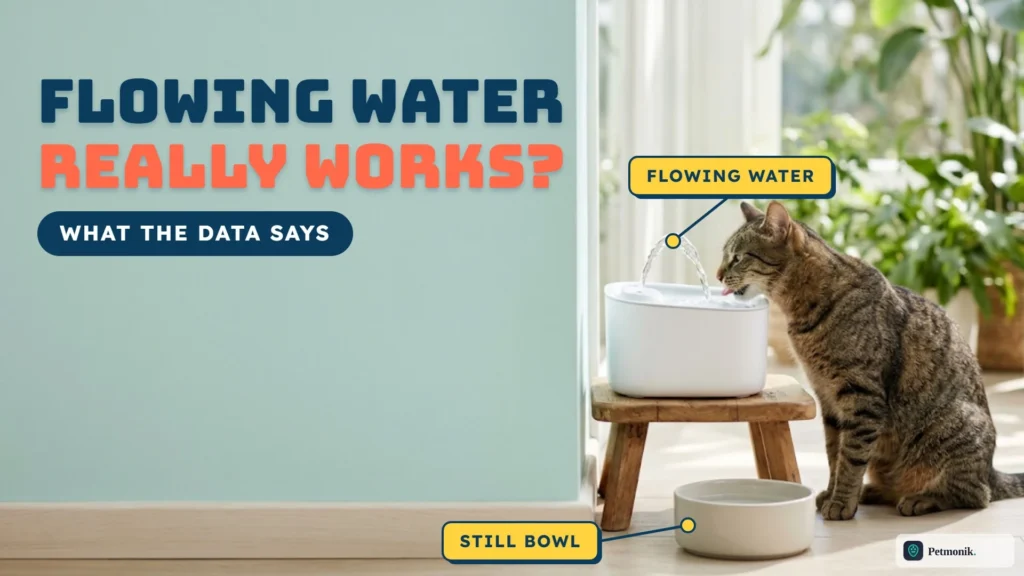
You bought the fountain because every article promised that cats love moving water. A week later your cat still sniffs it, walks away, and drinks from the bathroom tap. So do cats drink more from a flowing water fountain, or is that just good marketing? The honest answer is more interesting than a simple yes. Controlled feline nutrition trials show a much more nuanced picture than marketing claims suggest: individual cats often show strong personal preferences, even when group-wide intake averages barely budge. Below we separate peer-reviewed veterinary data from brand hype, then show how to use a smart fountain’s hydration log to test your own cat. Most searches for “do cats drink more flowing water fountain” end in sales pitches; here is what the clinical evidence actually shows.
Quick Summary: Flowing Water and Cat Drinking
- Many cats seem to prefer moving water. International Cat Care advises considering running water sources because some cats like to drink from moving water.
- The proof is thin. Controlled trials (such as Grant 2010 in the Journal of Feline Medicine and Surgery) found no dramatic group-wide jump in urine dilution from fountains alone, though individual cats clearly favored one vessel over another.
- Setup matters as much as flow. Bowl location, width, material and diet all affect how much a cat drinks.
- Smart fountains let you test it. A two-week log of drinking before and after a switch tells you what works for your cat.
Why Cats Are Said to Prefer Flowing Water
A veterinarian writing for PetsRadar offers four theories, and is upfront that we cannot ask cats why they behave this way:
- Freshness. Moving water seems cleaner and safer than still water, which can harbor bacteria and parasites.
- Movement. Cats’ senses are highly attuned to movement, so a stream grabs attention.
- Whisker comfort. Running water may avoid the whisker contact some cats dislike in a deep bowl. This is also unproven, which we cover in our whisker fatigue fountain guide.
- Play. Some cats simply find moving water fun.
These are educated guesses from evolution and biology. None of them proves that a given fountain will raise your cat’s intake.
What the Evidence Actually Shows
Here is how clinical veterinary research, feline welfare organizations, and smart fountain brands compare on the question:
| Source | What it says | Evidence cited |
|---|---|---|
| Grant (2010), J. Feline Med. Surg. | Compared circulating fountains vs. still bowls in home-living cats | Slightly higher fountain intake in some cats, but no statistically significant group-wide drop in urine osmolality |
| International Cat Care | Recommends trying running water introduced gradually, alongside wide shallow bowls away from food | Feline welfare consensus based on behavioral preference |
| Veterinary behaviorists | Highlight freshness cues, visual motion, whisker clearance, and play drive | Behavioral hypotheses explaining why specific cats favor moving streams |
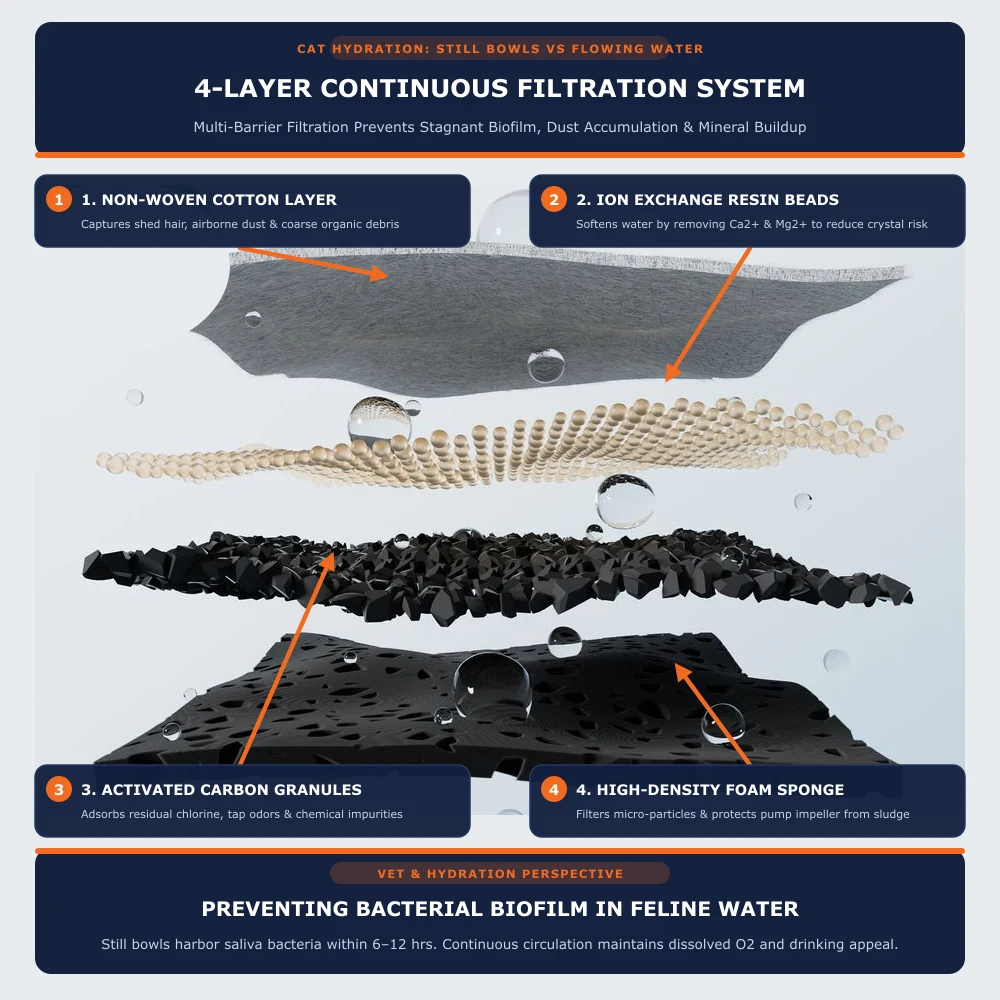
| Smart fountain brands | Market continuous 4-stage filtration and flowing streams to encourage hydration | Owner survey claims rather than controlled clinical endpoints |
Key takeaway from controlled trials: group averages hide strong individual cat preferences, which is why tracking your own cat’s baseline matters most.
The takeaway is not that fountains fail. Vets and cat-care groups consistently recommend trying one. It is that you should treat the benefit as a good bet for many cats rather than a guarantee, and judge success by your own cat’s behavior.
What Else Changes How Much a Cat Drinks
A fountain is one variable among several, and sometimes not the biggest one. International Cat Care lists these:
- Placement. Keep water away from food, in a quiet spot away from doors and machinery, where the cat can approach from all sides.
- Bowl width. Wide, shallow bowls avoid whisker contact. Fill them to the brim.
- Material. Cats generally favor glass and ceramic over plastic.
- Diet. A wet diet adds water to the cat’s day. Purina notes that cats on wet food drink less because the food contains moisture.
- Mobility. Arthritic cats may do better with elevated bowls.
If your cat ignores a new fountain, one of these may be the reason, not the water flow. Also keep the fountain clean, since a slimy pump can put a cat off; see our guide to cleaning a smart pet fountain pump.
How to Test Flowing Water With Your Smart Fountain Data
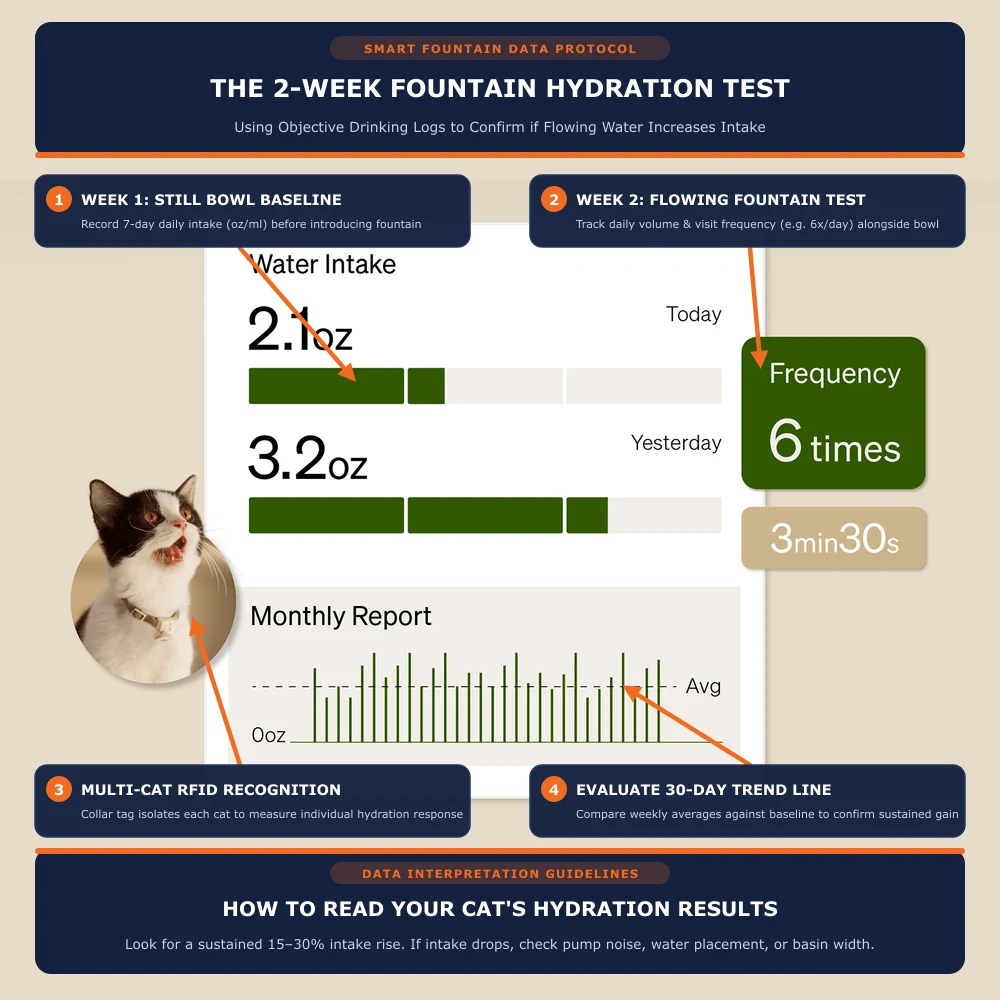
This is where smart fountains earn their price. Instead of guessing, you can run a simple before-and-after comparison, as long as your fountain or app logs water use. Our overview of smart water fountain hydration tracking explains what the data looks like.
A Simple Two-Week Test
- Week 1 (baseline). Keep your usual bowl. If you have a tracking bowl or scale, record daily intake. Otherwise measure what you pour in and what is left.
- Week 2 (fountain). Introduce the fountain gradually, keeping the old bowl nearby for the first days, as International Cat Care advises.
- Keep everything else constant. Same food, same room, same location where possible.
- Compare the averages, not single days.
Log Template
| Day | Setup | Water used (ml) | Notes |
|---|---|---|---|
| 1-7 | Regular bowl | Record daily | Weather, food, activity |
| 8-14 | Fountain plus old bowl | Record daily | How often the cat visits it |
| Compare | Average of each week | Difference | Anything else that changed |
Reading the Result
- Intake rose: the fountain is working for this cat. Keep it clean and the filter fresh.
- No change: that is fine if she was already drinking enough. Try placement or a wider basin before giving up.
- Intake fell: go back to the bowl, and look at noise, location and cleanliness.
- Big swings with no clear cause: call your vet. Increased thirst can go with kidney disease, diabetes, hyperthyroidism and other conditions.
Hot weather or a switch between dry and wet food can move the numbers by themselves, so note them in the log. A fountain’s water usage can also include evaporation and splashing, so treat the figures as a trend, not an exact measure of what your cat swallowed.
Features to Look for in a Smart Fountain
| Feature | Why it matters for a drinking test |
|---|---|
| Water level or usage log | Gives you the before-and-after numbers |
| Per-cat identification (RFID) | Needed in multi-cat homes to know who drank |
| Low noise rating | A loud pump can put a cautious cat off |
| Wide, open basin | Reduces whisker contact |
| Easy-clean pump | Clean water is a likely part of the appeal |
| Adjustable flow | Lets you slow the stream for a nervous cat |
If you want a full monitoring setup, our guide to a feeder, camera and fountain bundle covers how fountains fit with the rest of your devices.
If Your Cat Still Will Not Use the Fountain
- Place the fountain next to the old bowl and move it gradually.
- Move it away from food and the litter box.
- Turn the flow down or try a different spot if the sound seems to bother her.
- Offer more than one water station around the home.
- Add water to wet food if your cat accepts it.
- If she drinks very little, drinks far more than usual, or seems unwell, see your vet.
The bottom line: many cats do seem to like flowing water, and trying a fountain is a low-risk step that vets and cat-care groups support. Controlled veterinary studies show that a fountain alone does not automatically dilute urine in every cat—individual preference decides the outcome. Use your fountain’s log to find out what is true for your cat. Petmonik will update this guide if stronger research appears.
Frequently Asked Questions
Do cats drink more from a flowing water fountain?
Some individual cats drink noticeably more, which is why feline welfare groups recommend trying running water—though controlled trials (such as Grant 2010 in JFMS) found no guaranteed group-wide increase in urine dilution. Track your own cat’s baseline to be sure.
Why do cats prefer running water?
Theories include freshness, attraction to movement, avoiding whisker contact with bowl sides, and play. These are educated guesses because we cannot ask cats.
Is a water fountain better than a bowl for cats?
It can be for some cats, but a wide, clean bowl in a quiet spot, away from food, may work just as well. Placement, material and diet also change how much a cat drinks.
How can I tell if my cat is drinking enough?
Measure daily water use for a week, then compare it after a change. Needs vary by cat and diet; Purina gives about 7 ounces a day for a 9-pound cat as a guide, and wet food lowers how much a cat drinks.
How long should I give my cat to accept a new fountain?
There is no fixed time. International Cat Care advises introducing it gradually, so keep the old bowl available while your cat explores.
When should I worry about how much my cat drinks?
Call your vet if your cat suddenly drinks much more or much less than usual, especially with changes in appetite, behavior or litter box habits.