

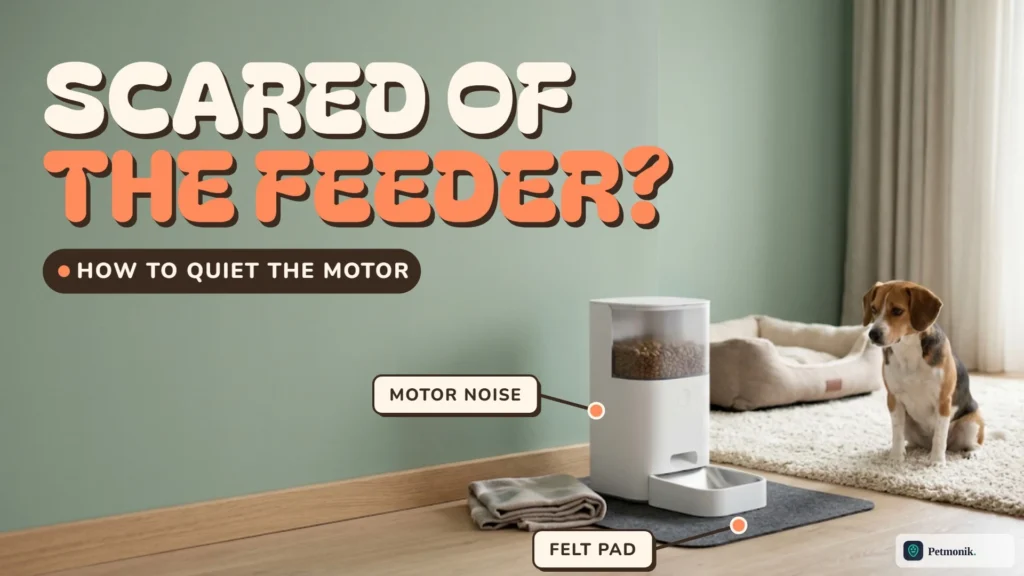
The motor whirs, a handful of kibble clatters into the bowl, and your dog bolts under the bed. Now she will not go near the kitchen at mealtime, and the feeder you bought to make life easier has made it harder. If you are searching for a quiet automatic pet feeder for a scared dog, here is the first thing to know: most pet-feeder brands omit motor and kibble-drop decibel ratings from their spec sheets, making “quiet” claims hard to compare on paper. The good news is that fear of a sound can usually be reduced with gradual exposure and rewards, which is the approach vets and animal charities recommend. Below we pair a step-by-step desensitization routine with practical ways to dampen bowl clatter and mute built-in alerts. A quiet automatic pet feeder scared dog plan starts with training, not hardware.
Quick Summary: Helping a Timid Dog With a Noisy Feeder
- Do not force it. PDSA warns against flooding, which means keeping a dog close to a feared noise, because it makes anxiety worse.
- Go slowly and reward calm. Blue Cross and VCA describe pairing the sound with treats at a volume low enough that there is no fear response.
- Feeder decibel specs are rarely listed. While brands like Petlibro publish dB ratings for water fountains (23 to 30 dB), neither Petlibro nor PETKIT lists an acoustic figure for dry-kibble feeders because bowl-drop clatter varies with kibble size and dish material.
- Rule out a health cause. If fear is sudden or severe, talk to your vet; pain and hearing problems can contribute.
Why a Feeder Noise Can Frighten a Dog
VCA says roughly one-third of dogs have some aversion to noise, and that fear can come from a single bad experience, repeated exposure, or genetics. A feeder adds a few specific triggers:
- Sudden sound. A motor starting or kibble dropping into a bowl with no warning.
- Movement. Lids, doors or flaps that open and close.
- Unpredictability. A feeder that fires when the dog is standing next to it.
- Timing. If the noise happens when she is already hungry or tense.
- Digital sounds. A recorded meal call or beep, if your model has one.
PDSA lists the common signs of fear: trembling, a tucked tail, hiding, barking, whites of the eyes showing and toileting indoors. If you see these around the feeder, treat them as information, not bad behavior.
Is the Problem the Feeder or the Dog?
Before you blame the machine, check these:
- Is the fear sudden? VCA notes that ear infections, arthritis and hearing loss can contribute, especially in senior dogs. Ask your vet.
- Does she fear other noises? Thunder, vacuums or fireworks point to a general noise sensitivity, not just this feeder.
- Does she avoid the area, not just the feeder? The room or spot may be the issue.
- Did something else change? A move, a new pet or a change in routine.
If your dog panics even at low volumes, Blue Cross advises seeing a vet or a certified behaviorist first. PDSA also says some severe cases need behavior-modifying medication alongside training, so do not try to push through alone.
How to Get a Timid Dog Used to a Feeder, Step by Step
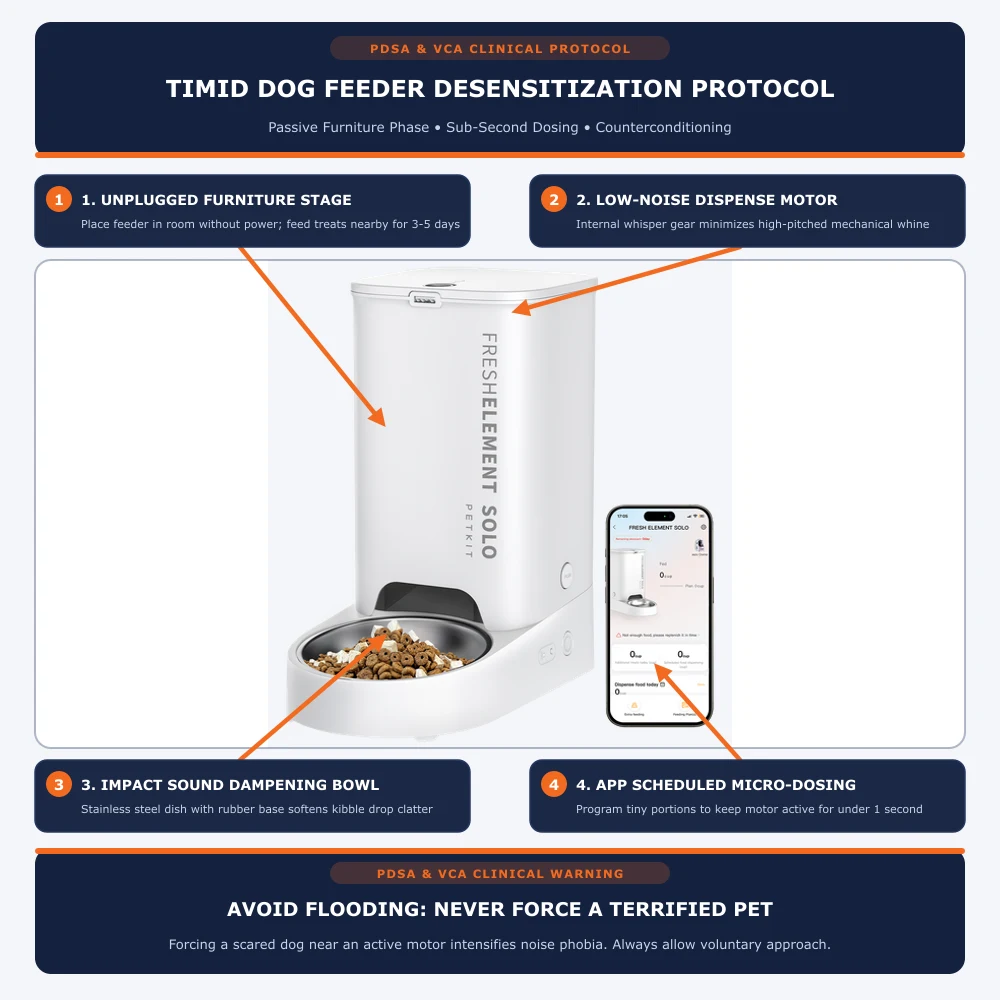
This follows the desensitization and counterconditioning method that Blue Cross, PDSA and VCA describe for noise. The speed is set by your dog, not by us.
Step 1: Keep the Old Bowl and Make the Feeder Boring
Put the feeder in the room, unplugged, and keep feeding from her normal bowl. Let her see it without anything happening. Leave a treat near it once a day so it predicts something good.
Step 2: Introduce the Sound at a Distance
Run the feeder when your dog is far away, in another room if possible, while she is enjoying a meal or a chew. Blue Cross recommends starting at a barely noticeable volume and stopping if you see panting or hiding.
Step 3: Pair the Sound With Something Great
Make the feeder sound the start of good things: a treat, a game or her dinner. This is classical conditioning, as VCA describes it. Keep the sound low enough that she shows no fear.
Step 4: Move Closer, Slowly
Over days or weeks, reduce the distance only when she stays relaxed. If she shows any fear, PDSA says to reduce the noise level until she is completely comfortable, which in feeder terms means going back a step.
Step 5: Move One Meal at a Time to the Feeder
Once she is calm, serve one meal a day from the feeder while the old bowl stays available. Do not remove the bowl until every meal is accepted. For the general method of moving a pet to a machine, see our guide to transitioning to an automatic feeder, which uses the same gradual approach for cats.
What Not to Do
- Do not punish or scold. VCA says punishment increases fear.
- Do not flood her. PDSA describes flooding as prolonged exposure to the feared noise, and says it intensifies anxiety.
- Do not over-comfort. VCA notes excessive comforting may teach a dog to seek reassurance when anxious. Stay calm and matter-of-fact.
- Do not drag her to the feeder. Let her choose to approach.
- Do not remove her old bowl until she eats confidently from the new one.
Reducing the Noise Itself
You cannot make a feeder silent, but you can often make it gentler:
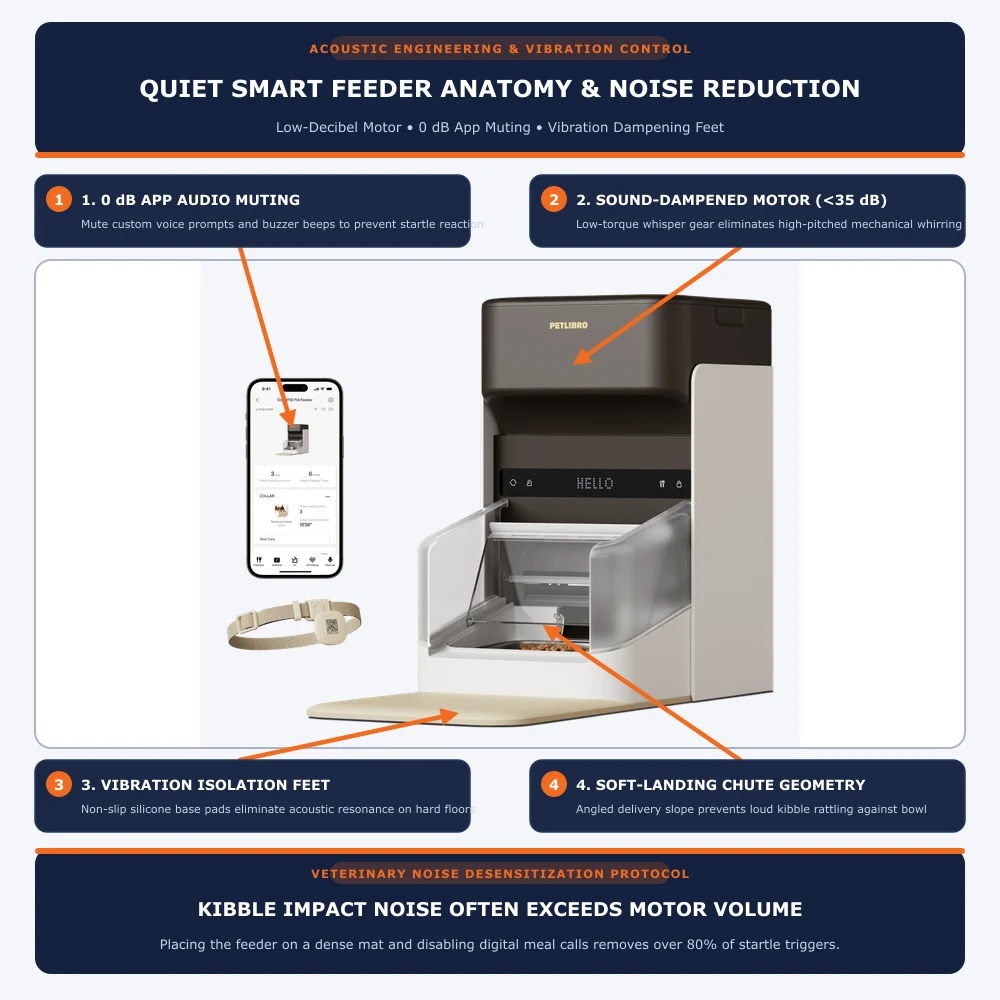
- Mute voice calls and system tones. On Petlibro Granary feeders, you can clear a recorded meal call by unlocking the panel and double-pressing the record button, or set meal-call playback and volume to zero in the PETLIBRO app. On PETKIT smart feeders with speaker alerts, toggle off system or voice sounds in the device settings menu.
- Soften the landing. Kibble striking an empty stainless-steel tray is usually louder than the rotor motor itself; placing a food-grade silicone slow-feeder insert in the tray, or leaving a few pieces of kibble to cushion the first drop, noticeably dampens the metallic clatter.
- Place it on a stable, non-hollow surface. A feeder on a thin shelf can amplify vibration.
- Move it away from her bed or crate so she can rest without hearing it.
- Schedule it when you are home for the first weeks so you can reward calm behavior.
Feeder Noise Ratings: What the Brands Publish
| Brand / product | Published dB rating | Acoustic & audio notes |
|---|---|---|
| Petlibro Granary series | Not rated by brand | Low-RPM rotor motor; recorded voice meal call can be cleared or muted to 0; peak noise is kibble hitting the stainless tray |
| PETKIT Fresh Element Solo | Not rated by brand | No voice-recording speaker; brief impeller hum during dispensing plus kibble drop into ABS or stainless-steel bowl |
| Petlibro Dockstream fountain | 23 dB | Continuous water-pump benchmark for comparison (fountain, not a kibble feeder) |
| Petlibro stainless steel fountain | 30 dB or less | Continuous water-pump benchmark for comparison (fountain, not a kibble feeder) |
Why don’t feeder brands publish decibel specs? Unlike a continuous water pump, a feeder’s peak volume comes from dry kibble striking an empty metal or plastic dish rather than the motor itself, so real-world loudness changes with kibble density, drop height, and bowl material.
Is an Automatic Feeder Right for a Fearful Dog?
| Situation | A feeder may suit if | Consider something else if |
|---|---|---|
| Mild startle at the sound | She recovers quickly and eats after | She leaves the room and skips meals |
| General noise phobia | You can work with a trainer or vet | She panics at low volumes |
| Senior dog with sudden fear | A vet has checked for pain and hearing loss | The fear began suddenly and unexplained |
| You travel often | Training is complete before you leave | You would rely on it untrained |
If you are not sure a feeder is worth it, our guide on whether you need an AI pet feeder can help you decide. For power cuts, which can add new noises and stress, see our battery backup guide.
When to Call a Professional
- Your dog panics at low volumes of the sound.
- She refuses food for more than a short time.
- The fear is spreading to other rooms or sounds.
- You see destructive behavior or escape attempts.
- The fear began suddenly in a senior dog.
Large dogs react differently to feeders than small ones; see our guide to smart feeders for large breed dogs.
The bottom line: a scared dog and a noisy feeder can be made to work together, but only at the dog’s pace. Keep the old bowl, pair the sound with rewards, never force it, and see a vet or behaviorist if the fear is strong. Mute any meal-call chimes, cushion the bowl landing, and let calm body language set the schedule.
Frequently Asked Questions
Is there a quiet automatic pet feeder for a scared dog?
Major brands like Petlibro and PETKIT do not publish decibel ratings for kibble feeders because bowl-drop clatter outweighs motor hum. Choose a model that lets you mute voice calls, cushion the dish during training, and introduce the feeder gradually.
How do I get my dog used to the feeder noise?
Use desensitization and counterconditioning: play the sound at a very low level or distance while your dog enjoys treats or a meal, and increase it only while she stays relaxed.
How long does it take a fearful dog to accept a feeder?
It depends on the dog. Blue Cross describes increasing volume over days, weeks and months, so follow her signals, not a calendar.
Should I stop using the feeder if my dog is scared?
Pause and go back a step. Keep feeding from her old bowl, and call your vet or a behaviorist if she panics at low volumes or stops eating.
Can I mute the sounds on my smart feeder?
Yes on most app-connected feeders: Petlibro Granary models let you clear the voice meal call or set playback volume to zero in the app, and PETKIT smart feeders allow toggling off voice or system prompt tones in device settings.
Could my dog’s fear be a health problem?
Possibly. VCA notes that ear infections, arthritis and hearing loss can contribute to noise fear, especially in senior dogs, so ask your vet if the fear is sudden.