

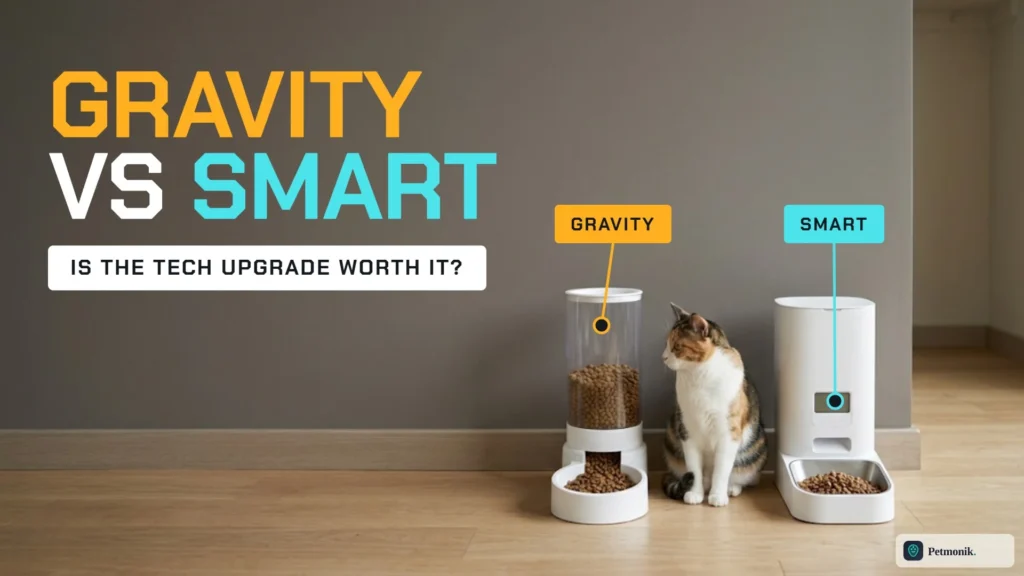
A $20 gravity feeder sits next to a $70 automatic feeder on the shelf, and both promise the same thing: your pet will not go hungry while you are away. The cheap one needs no app, no Wi-Fi and no batteries. So what exactly are you paying for with the upgrade? That is the real question behind gravity feeder vs automatic feeder shopping, and the answer depends less on technology than on your pet. Does your cat self-regulate? Do you have two pets with different diets? Do you travel? Below we compare free-feeding hoppers, non-Wi-Fi programmable dispensers, and app-connected smart feeders across calorie control, multi-pet homes, and real-world upkeep.
Quick Summary: Gravity or Automatic Feeder?
- Gravity feeders are cheap and simple. Catster puts them at roughly $15 to $30, with no electricity needed, but they cannot limit portions.
- Automatic feeders control portions and timing. Entry-level programmable and smart models like the Petlibro Granary and PETKIT Fresh Element Solo typically retail around $70 MSRP.
- Most vets favor scheduled feeding because it allows more control over how much a cat eats and helps prevent obesity.
- The upgrade is worth it for pets that overeat, need a measured diet, or share a home with other pets. It is optional for a steady, lean eater.
How Gravity Feeders and Automatic Feeders Differ
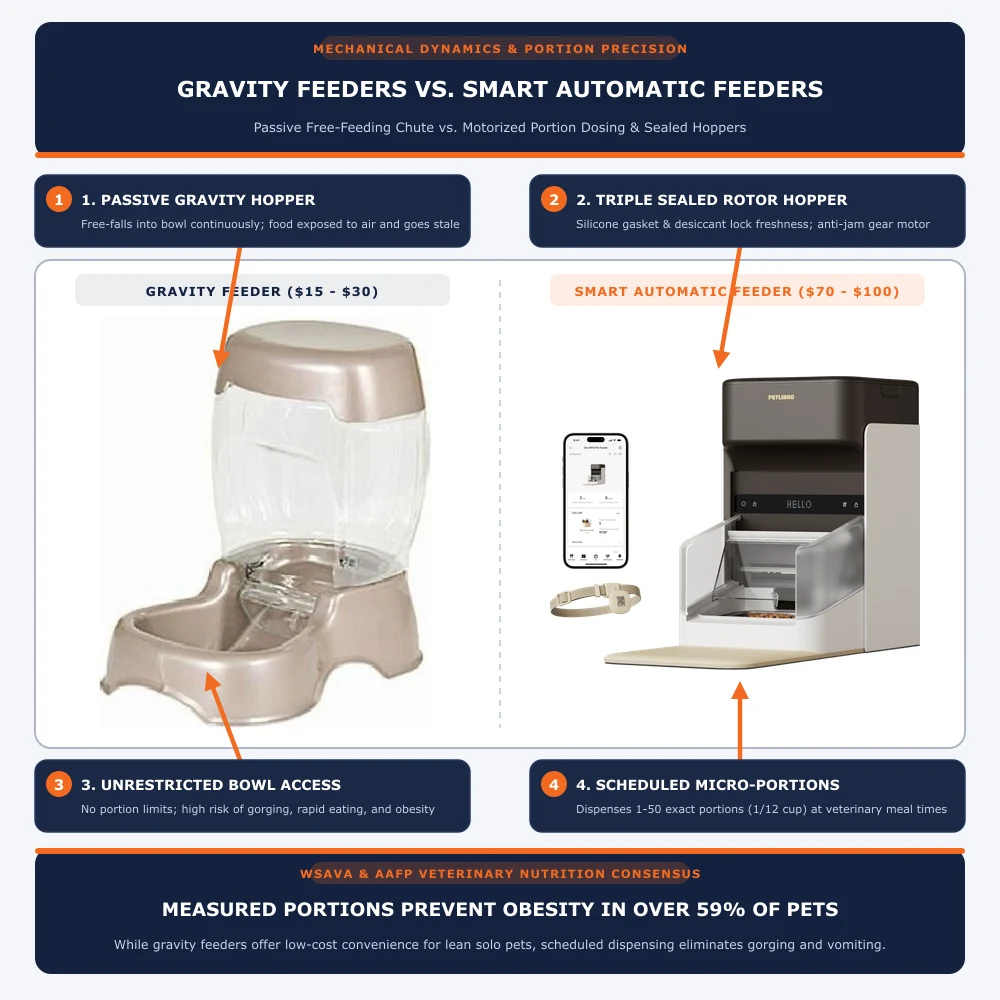
A gravity feeder refills the bowl from a storage container above whenever there is space, so food is available all day. An automatic feeder dispenses set portions at set times, and a smart one adds an app on top. There is also a middle tier: automatic feeders with scheduling but no Wi-Fi. Petlibro’s basic Granary, for example, schedules up to six meals or snacks a day with 1 to 50 portions per meal, but has no app control.
Gravity Feeder
- Continuous access to dry food.
- No power, no app.
- Cannot limit how much your pet eats.
Automatic (Scheduled) Feeder
- Fixed portions at fixed times.
- Runs on mains power with battery backup on many models.
- Some models have no Wi-Fi, which makes them simpler and less exposed to online risks.
Smart (App-Connected) Feeder
- Everything an automatic feeder does, plus remote control, feeding records and alerts.
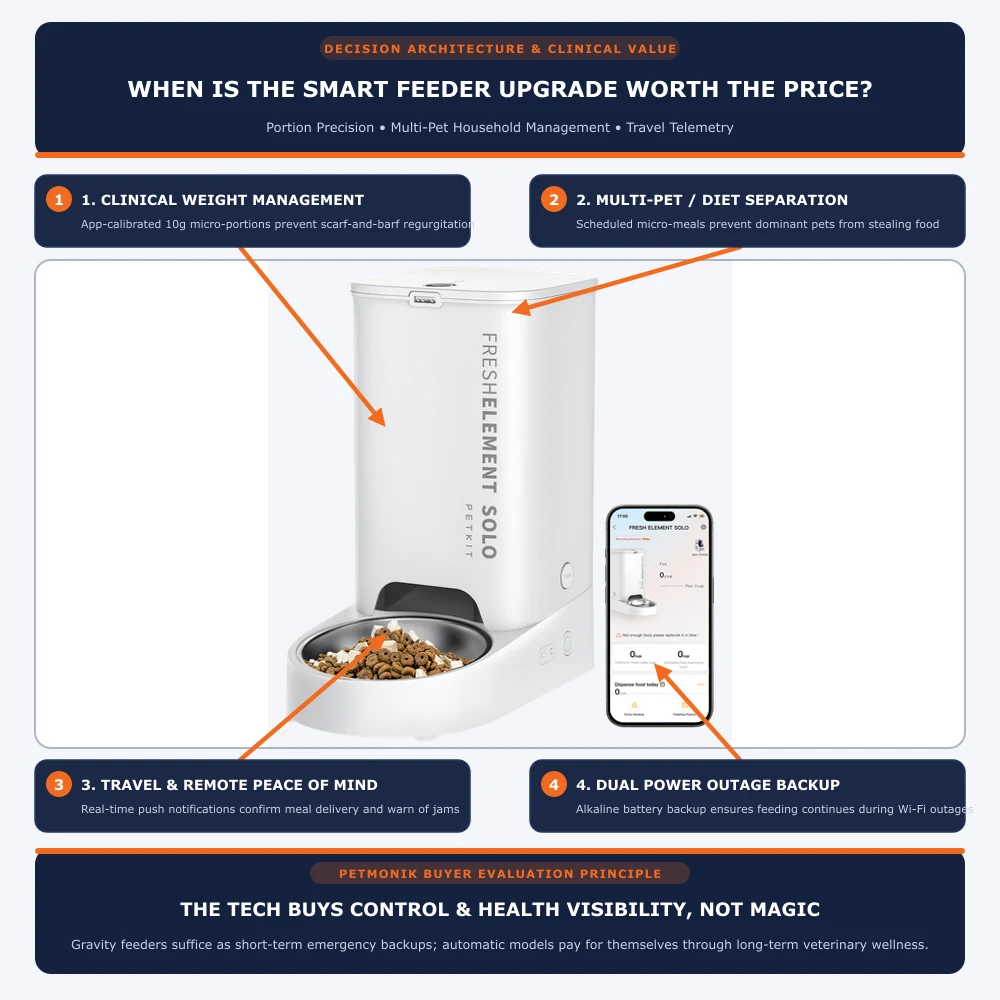
- PETKIT’s Solo lists app scheduling, 1 to 5 portions of about 10 g each, low food alerts and feeding records.
- Needs Wi-Fi, and the PETKIT page says it supports 2.4 GHz.
What Vets Say About Free Feeding vs Scheduled Feeding
From a feline nutrition standpoint, free feeding and scheduled meals carry clear trade-offs:
| Method | Advantages | Drawbacks |
|---|---|---|
| Free feeding (gravity) | Suits unpredictable schedules and multi-cat homes, picky eaters, weight-gain recovery and kittens | Cannot be used with canned food; significant obesity risk if a cat lacks self-control; harder to tell whether a cat is eating |
| Scheduled feeding (automatic) | Precise calorie control; easier to spot appetite changes or illness; predictable budget and less waste | Needs consistent timing; a demanding cat may keep asking for more |
Veterinary nutritionists generally favor scheduled feeding because it gives you direct control over daily calories and helps prevent gradual weight gain, though the right fit still depends on your cat’s temperament and household routine. Catster’s gravity feeder guide adds that these feeders suit busy owners who want an affordable backup for occasional absences, and are not appropriate for weight-conscious cats or those needing portion control.
Gravity Feeder vs Automatic Feeder: Cost and Feature Comparison
| Factor | Gravity feeder | Automatic feeder (no Wi-Fi) | Smart feeder (app) |
|---|---|---|---|
| Typical retail price | About $15 to $30 | Around $70 MSRP (e.g., Petlibro Granary) | Around $70 MSRP (e.g., PETKIT Fresh Element Solo) |
| Portion control | None | Yes: up to 6 meals, 1 to 50 portions per meal (Petlibro Granary) | Yes: app-set portions (PETKIT Solo: 1 to 5 portions of about 10 g) |
| Scheduling | No | Yes | Yes, with remote changes |
| Power | None needed | Wall adapter plus backup batteries (Petlibro lists 3 D batteries) | Wall adapter plus battery backup on many models |
| Remote control and alerts | No | No | Yes (low food, feeding records) |
| Wet food | No | No (Petlibro Granary is dry food only) | Usually no; wet food needs a specific model |
| Ongoing costs | Minimal | Batteries and desiccant bags | Same, plus filters or subscriptions on some models |
Retail prices reflect standard manufacturer MSRPs before seasonal discounts; camera-equipped or RFID-selective smart feeders sit in a higher tier ($110 to $180+).
When a Gravity Feeder Is Enough
- One lean, steady eater who does not gorge.
- A short backup for an unexpected delay or a day out.
- Dry food only and no need to track intake.
- A tight budget.
- A secondary feeder in a second room.
Catster’s caveat applies: a gravity feeder should supplement, not replace, your attention and routine. Because food is always there, you will not notice a drop in appetite as quickly, which is one of the main clinical drawbacks of open free feeding.
When the Upgrade Is Worth the Price
Your Pet Gains Weight Easily
If your pet overeats, measured portions matter. Our guide on portion control with an automatic feeder explains how to set grams for a weight plan.
You Have More Than One Pet
Free feeding works in multi-cat homes only when cats eat peacefully together, per Catster. If one pet needs a different diet or steals food, you need a controlled feeder. Our guide on smart feeders for multiple cats on a prescription diet covers that case.
You Travel or Work Long Hours
A scheduled feeder gives your pet the same meal times every day, and a smart one lets you check it. To size the hopper for a trip, see our feeder capacity guide for weekend trips.
You Want to Notice Changes Early
Measured meals make subtle appetite drops and early signs of illness much easier to spot than a constantly topped-up gravity bin, and smart-feeder logs make that pattern even clearer when you review them regularly.
The Hidden Costs and Risks of Going Smart
- Connectivity. Wi-Fi drops leave you without remote control; see our offline fix guide.
- Power cuts. Backup runtime varies; see our battery backup guide.
- Privacy. Connected feeders mean an online account; see our pet camera privacy guide.
- Maintenance. Petlibro recommends replacing the Granary desiccant bag every two weeks.
- Jams. Kibble size limits apply; Petlibro lists 2 to 15 mm for the Granary.
A smart feeder is a device with moving parts, software and an account. A gravity feeder has none of these, which is also its biggest advantage.
Decision Guide: Which Feeder Should You Buy?
| Your situation | Best fit |
|---|---|
| Lean cat, occasional absences, tiny budget | Gravity feeder as backup |
| Pet on a weight plan or measured diet | Automatic or smart feeder with portion control |
| Multi-pet home with different diets | Selective or RFID feeder, not gravity |
| Frequent travel and you want check-ins | Smart feeder, ideally with backup power |
| You want the simplest, most private setup | Automatic feeder without Wi-Fi |
| Wet food | A feeder designed for wet food; gravity does not work |
If you are still unsure whether the tech is for you, read whether you need an AI pet feeder.
The bottom line: the extra money buys control, not magic. If your pet eats sensibly and you only need a backup, a gravity feeder is fine. If portions, schedules or multiple pets matter, an automatic feeder pays for itself in predictability, and a smart one adds visibility if you will use it. Match the feeder tier to your pet’s eating habits rather than paying for app features you will never open.
Frequently Asked Questions
What is the difference between a gravity feeder and an automatic feeder?
A gravity feeder refills the bowl from a container above, so food is always available. An automatic feeder dispenses set portions at set times, and smart models add app control.
Is an automatic feeder worth it over a gravity feeder?
It is worth it if your pet overeats, needs measured portions or shares a home with other pets. For a lean, steady eater who only needs a backup, a gravity feeder can be enough.
How much does a gravity feeder cost compared with an automatic feeder?
Basic gravity feeders typically cost $15 to $30, while entry-level programmable and app-connected automatic feeders like the Petlibro Granary and PETKIT Fresh Element Solo carry a standard $69.99 MSRP before sales.
Do vets recommend free feeding with a gravity feeder?
Most vets favor scheduled feeding because it allows more control over how much a cat eats and helps prevent obesity, though the best method depends on the cat.
Can a gravity feeder handle wet food?
No. Gravity feeders are for dry food, and free feeding is not suitable for canned food because of spoilage.
Do I need Wi-Fi for an automatic feeder?
No. Some automatic feeders schedule meals without an app, such as Petlibro’s basic Granary. Wi-Fi adds remote control and alerts.