

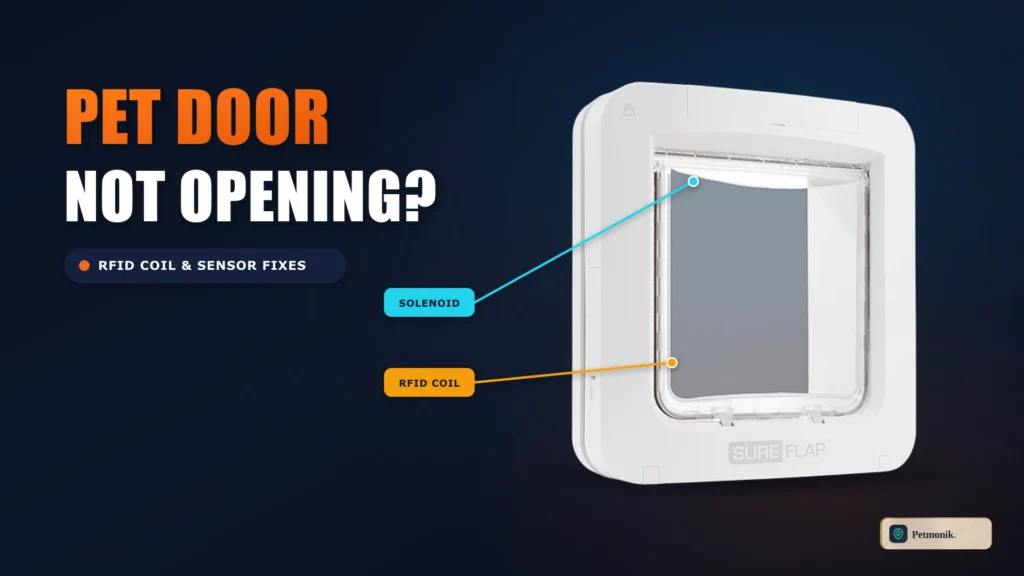
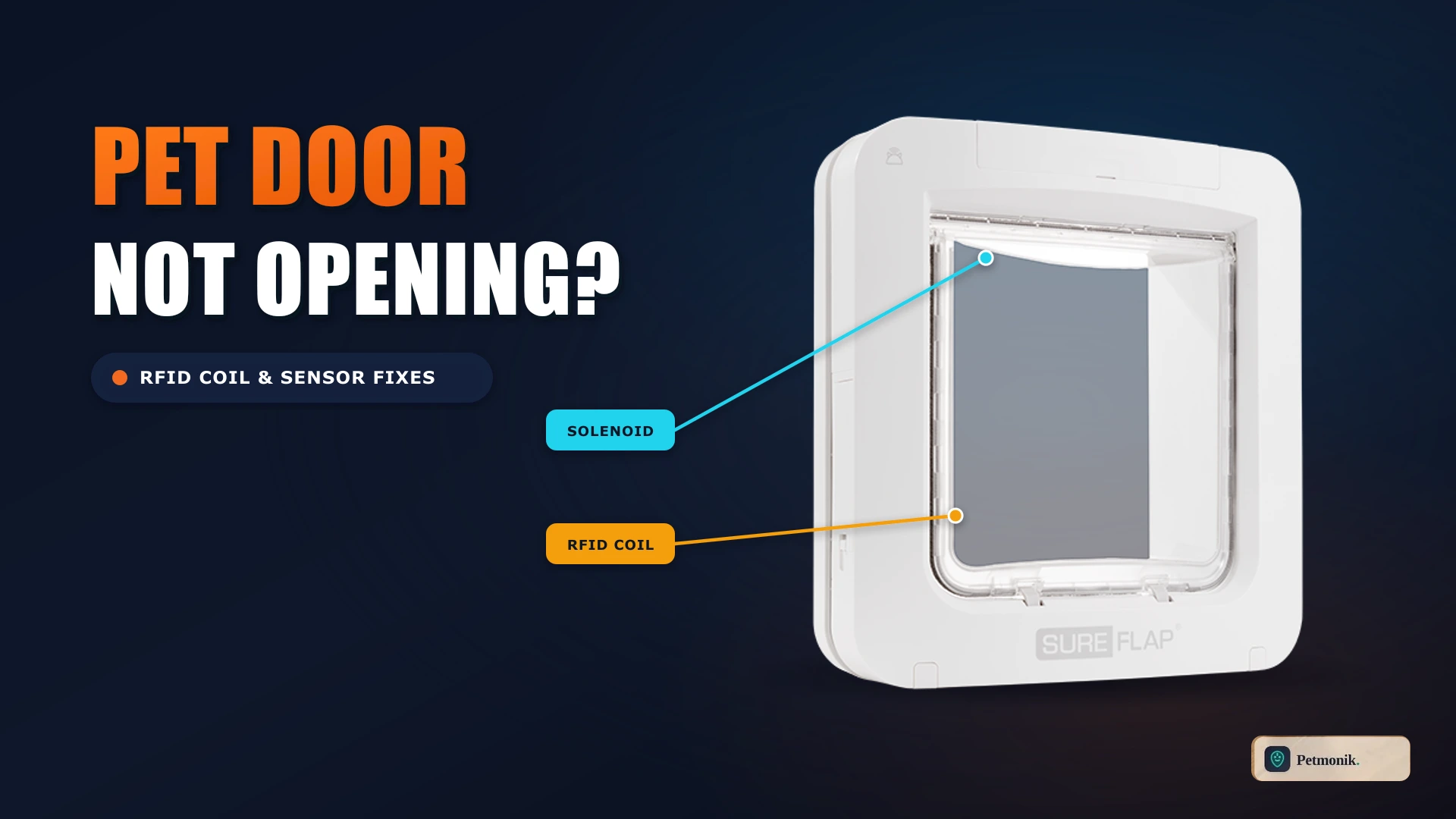
An electronic microchip pet door offers the ultimate balance between feline autonomy and home security—keeping nocturnal raccoons, stray neighborhood cats, and pests strictly outdoors while granting your microchipped pets seamless entry. However, few smart home scenarios are more distressing than watching your hesitant cat press their nose against the transparent flap, only for the lock solenoid to remain dead silent. When your flap stops responding, systematic microchip pet door sensor troubleshooting is the key to identifying radio-frequency attenuation, metal eddy currents, and firmware latency before your pet develops entryway anxiety.
Unlike passive optical or magnetic collar tags, microchip pet doors rely on low-frequency inductive RFID transceivers operating under strict international animal telemetry protocols. Even a minor electrical misconfiguration or a metallic door skin can collapse the invisible electromagnetic detection bubble. In this comprehensive technical guide, we explain the RF antenna physics behind pet microchip scanning, analyze the primary causes of read failures, and provide five field-tested fixes to restore flawless entryway automation.
Table of Contents
The Physics of 134.2 kHz RFID Pet Microchip Detection
Modern pet microchips—such as HomeAgain, Avid, and Datamars—are passive, glass-encapsulated transponders approximately the size of a grain of rice (12 mm × 2 mm). According to animal tracking telemetry standards formalized in ISO Standards 11784 and 11785, these implants contain no internal batteries. Instead, they rely strictly on near-field magnetic induction.
Embedded inside the pet door’s tunnel frame is a continuous loop antenna. The door circuitry pulses a 134.2 kHz alternating magnetic field into the tunnel opening. When your cat approaches, this electromagnetic flux induces a minute electrical current across the microchip’s microscopic copper ferrite antenna, charging an onboard ceramic capacitor. Once charged, the chip modulates the field, transmitting a 15-digit unique cryptographic ID back to the reader coils. If the received ID matches an authorized entry slot in the microcontroller EEPROM, the firmware energizes a dual-solenoid lock pin, dropping the mechanical catch in less than 300 milliseconds.
Why Microchip Pet Doors Fail to Read (Root Causes)
When an electronic pet flap intermittently ignores an approaching animal, the failure can almost always be traced back to four physical and electromagnetic constraints:
- Microchip Subcutaneous Migration: Microchips are implanted by veterinarians between the shoulder blades. Over months or years, physical movement and gravity can cause the implant to migrate down toward the lower ribs or shoulder joint. This increases the physical distance between the chip and the top tunnel antenna beyond the 4-to-6-inch effective read radius.
- Electromagnetic Eddy Current Damping: Installing a microchip pet flap directly into a steel, aluminum-clad, or metal-reinforced security door without an insulating spacer creates severe magnetic field degradation. The door’s metallic mass acts as an inductive short, dissipating the antenna energy as heat.
- Alkaline Internal Resistance Sag: Pet doors typically operate on 4 × AA or C-cell batteries. As alkaline chemistry ages, internal resistance spikes. The quiescent voltage may still read 1.4V per cell, but when the high-current reader coil bursts to full power, battery voltage sags below the operational threshold.
- Approach Velocity and Head Angle: If a timid or rushed cat dives through the flap with their head low, the transponder spends less than 150 milliseconds within the magnetic flux field—insufficient time for the passive chip capacitor to harvest energy and complete telemetry handshake.
Step-by-Step: 5 Proven Sensor Troubleshooting Fixes
If your smart door fails to unlatch consistently, execute these five structured diagnostic steps to isolate and resolve the issue:
1. Replace Alkaline Cells with High-Drain Lithium Batteries
Discard standard zinc-carbon or aging alkaline batteries. Upgrade immediately to 1.5V Energizer Ultimate Lithium cells. Unlike alkaline cells that experience gradual voltage drop and high internal resistance, lithium chemistry maintains a flat 1.5V curve across temperatures ranging from -40°F to 140°F. This guarantees maximum peak current delivery to the RFID emitter coil for maximum read range.
2. Map the Microchip Location with a Handheld Reader
Have your veterinarian or local animal shelter scan your pet to pinpoint the exact current anatomical location of the microchip. If the implant has migrated down the animal’s side, standard overhead antenna coils cannot detect it. In this case, pair the door with a lightweight RFID collar tag (such as the SureFlap or Cat Mate RFID pendant) that hangs centered right in front of the tunnel opening.
3. Clean and Calibrate Optical Chute Sensors
Most advanced microchip doors (like the PetSafe SmartDoor or SureFlap Microchip Connect) use dual infrared beam-break sensors inside the tunnel roof to detect an approaching animal before firing the power-hungry RFID reader coil. Spider webs, pet hair, and condensation coating the optical emitter lenses will prevent the RFID coil from triggering at all. Clean the optical lenses using an isopropyl-alcohol-dampened swab.
4. Extend Tunnel Depth with an RF Spacer Adapter
If your cat approaches with their head lowered, install an official tunnel extension adapter. Tunnel extensions physically force the animal to walk through a longer corridor, bringing their neck and shoulders directly underneath the RFID sensing zone for an additional 250 milliseconds before they reach the mechanical flap.
5. Perform a Clean EEPROM Re-Enrollment
Corrupted memory registers in the door microcontroller can cause intermittent failure to recognize valid IDs. Clear the memory by holding the Learn / Settings button for 10 seconds until all indicator LEDs cycle. Re-enroll your pet by placing a favorite treat inside the tunnel arch to coax them through naturally while the door is in learning mode.
Defeating Metal Door Interference and Eddy Current Attenuation
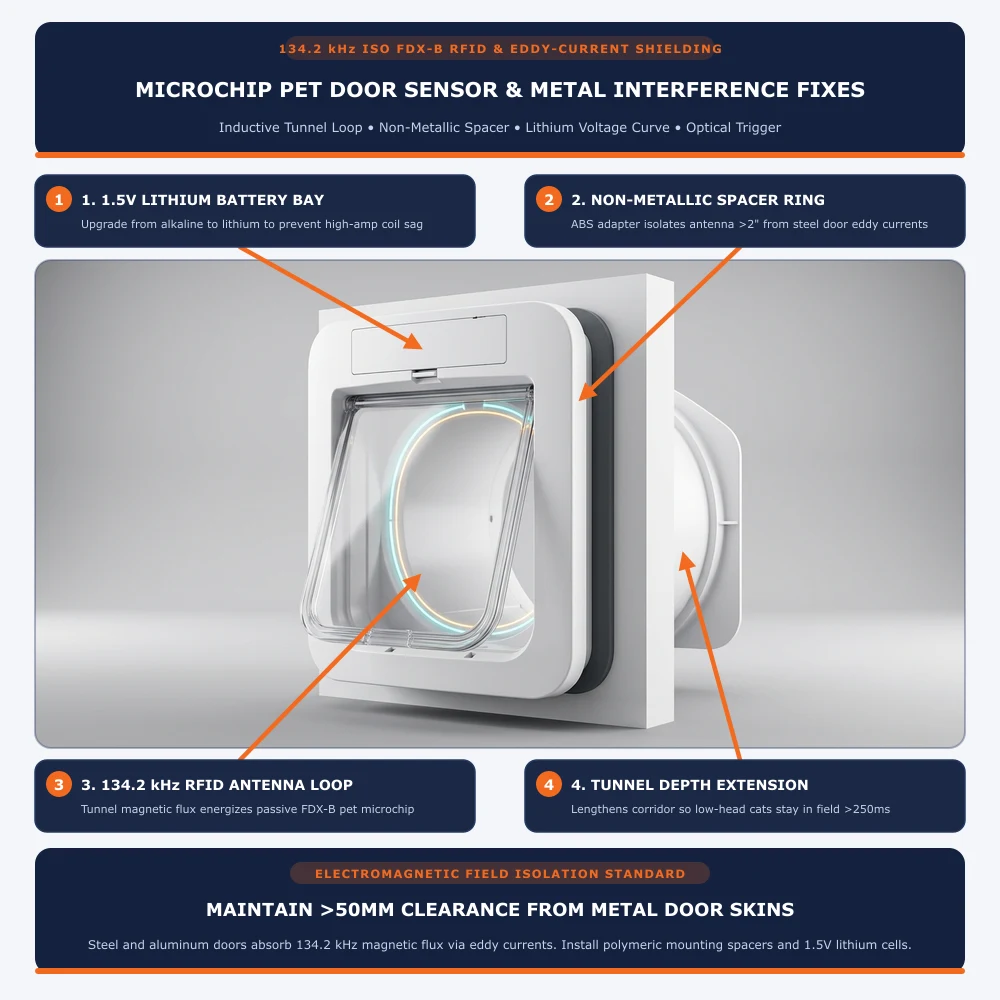
Installing a microchip door in a steel exterior door or aluminum-framed storm door requires specialized shielding techniques. When 134.2 kHz magnetic lines of flux cut across a continuous sheet of metal, circulating eddy currents form, producing an opposing magnetic field that cancels the reader signal:
- Use Non-Metallic Mounting Adapters: Always install an official circular mounting adapter kit made of rigid, non-conductive ABS or acrylic plastic. This separates the perimeter of the RFID loop antenna from the raw metal door cutout by at least 2 to 3 inches (50 – 75 mm).
- Avoid Metallic Fasteners Near Antenna Coils: Replace metal mounting screws with nylon or non-magnetic 316-grade stainless steel fasteners if they pass within 1 inch of the coil channel.
- Ferrite Sheet Decoupling: In extreme cases with heavy steel structural doors, apply flexible sintered ferrite magnetic shielding sheets (permeability $mu_r approx 100$) between the door body and the back of the antenna coil to redirect magnetic flux lines away from the metal skin.
Ecosystem Connectivity: Coordinating Doors with Smart Feeders
The microchip implanted under your pet’s skin is a universal biometric identifier across your connected smart pet ecosystem. If your pet learns to navigate their smart flap confidently, you can leverage that same passive RFID technology to prevent food stealing and manage specialized diets:
- Microchip Feeders for Multi-Pet Homes: Learn how to habituate hesitant pets to motorized access gates with our practical guide on training senior cats to use microchip feeders.
- Reliable Power During Severe Weather: Keep motorized door solenoids and feeders fully powered during unexpected storms by reviewing our technical breakdown on smart feeder battery backup times and UPS runtimes.
- Mechanical Maintenance: Ensure your pet appliances never suffer physical jamming by inspecting rotors and sensor chutes using our guide on automatic pet feeder jamming fixes and rotor clearing.