

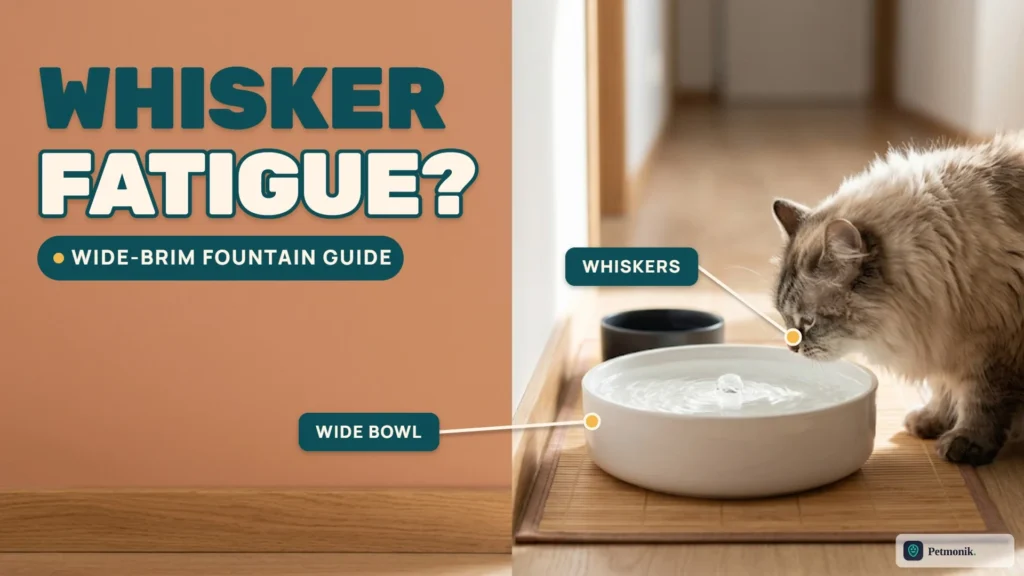
Your cat walks up to the water bowl, dips her head, pulls back, and then paws at the surface or drinks from the edge. Owners have a name for this behavior: whisker fatigue. The term is popular, but it is not an established veterinary diagnosis, and that matters when you shop. If you are searching for a smart water fountain for whisker fatigue, the practical question is simple: does the basin give your cat room to drink without her whiskers brushing the sides? Below we examine what feline veterinary research actually says about whisker sensitivity, how open-tray smart fountains compare on footprint and material, and how to measure clearance before you buy. Here is what to know about smart water fountain whisker fatigue claims before you buy.
Quick Summary: Wide-Basin Fountains for Whisker-Sensitive Cats
- Is whisker fatigue real? It is not scientifically established. Many vets are skeptical, so rule out dental pain and other medical causes first.
- What to look for: a wide, shallow drinking area, a stainless steel or ceramic surface, and quiet running.
- The catch: most brands publish overall dimensions and capacity, not the width of the drinking basin. Ask support or measure.
- Also consider: a plain wide, shallow dish next to the fountain as a low-cost test.
What Is Whisker Fatigue, and Is It Proven?
Whiskers (vibrissae) are packed with sensory nerve endings that help a cat judge space and movement. The idea behind whisker fatigue is that repeated contact with the sides of a narrow, deep bowl overstimulates them and makes eating or drinking unpleasant. Common signs people describe include:
- Hesitating at the bowl, then drinking from the rim.
- Scooping food or water out with a paw.
- Leaving food or water in the bowl even when hungry or thirsty.
- Standing over the bowl and pulling back repeatedly.
Here is the honest part. Research has not confirmed whisker fatigue as a condition, and a 2020 study summarized by PetMD found no difference in eating time or food eaten between whisker-friendly and regular bowls, though some cats did prefer the wider ones. Several veterinarians say the behaviors above are just as likely to come from dental disease, nausea, pain, or a simple dislike of a particular bowl or location. Increased thirst or a sudden change in drinking is a reason to call your vet, not to buy a new fountain. Once a vet has cleared medical causes, trying a wider vessel is low risk, which is why the advice is so widely repeated.
What Makes a Smart Fountain Wide-Brim and Whisker-Friendly?
There is no industry standard for a whisker-friendly fountain, so use these checks as a practical filter rather than a certification.
Basin Width and Depth
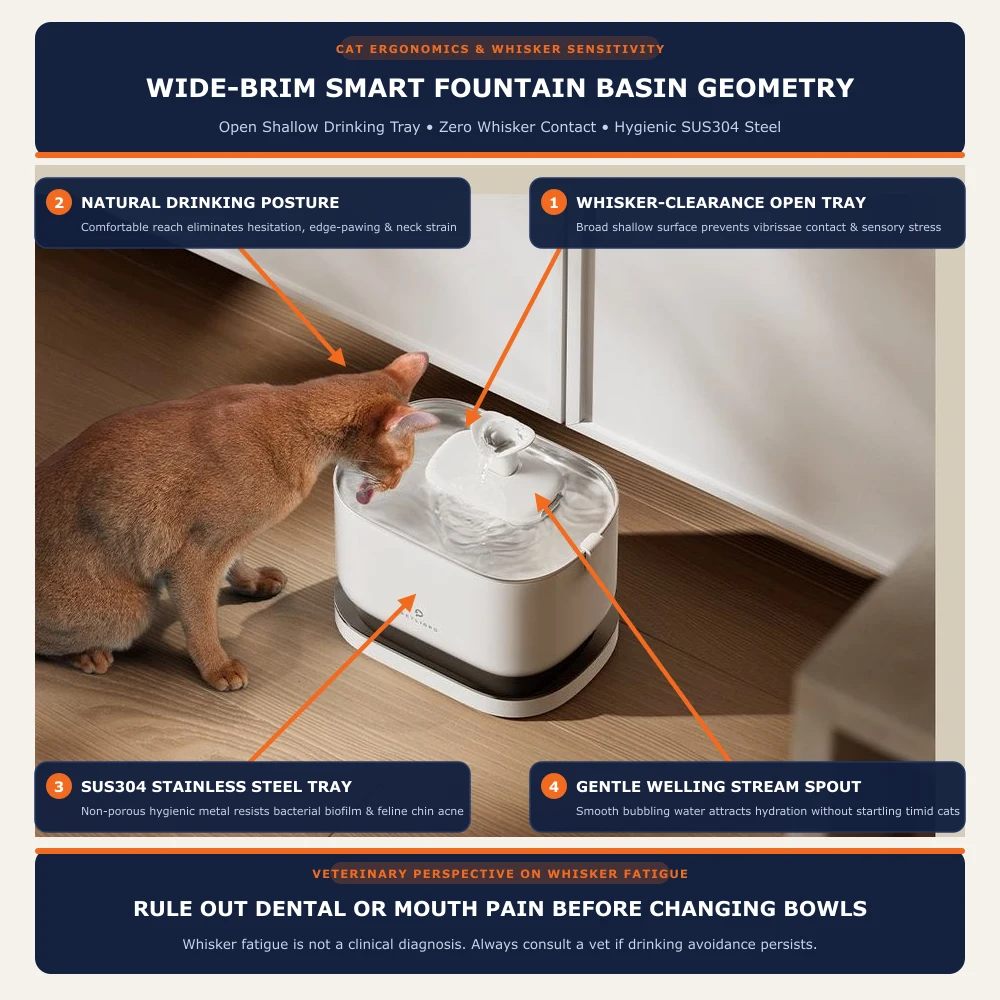
Pet-care guidance for whisker-sensitive cats usually describes a wide, shallow dish where the whiskers do not touch the sides. In a fountain, that means a large open tray or bowl rather than a tall narrow reservoir with a small drinking slot. Some brands list overall dimensions only, so a spec sheet that says 24 cm wide does not tell you how wide the water surface is.
Material
Stainless steel and ceramic scratch less than plastic. Petlibro notes that scratched plastic can hold bacteria more readily, which is a hygiene point rather than a whisker point, but it is a good reason to prefer a metal tray.
Noise and Flow
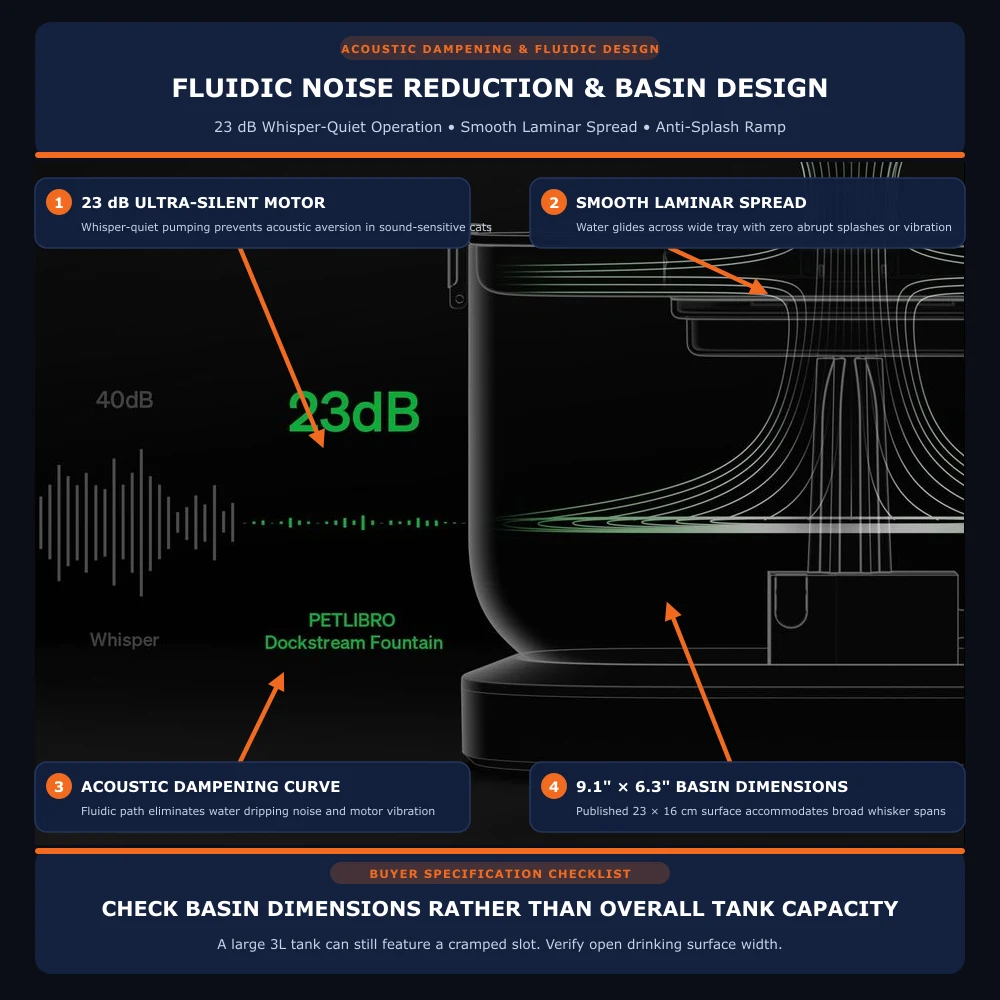
A cat that is wary of the bowl can also be put off by a loud pump or a strong splash. Look for a published decibel rating and a way to slow the flow.
Easy Cleaning
A wide basin is only useful if you keep it clean. A tray you can wipe by hand and a pump you can take apart will get cleaned more often. See our guide to cleaning a smart pet fountain pump for the full routine.
Wide-Basin Smart Fountain Options Compared
Most fountain brands publish outer housing dimensions rather than the exact inner tray diameter, so compare the overall footprint below against your cat’s whisker span.
| Model | Capacity | Drinking surface | Published size | Noise / connectivity |
|---|---|---|---|---|
| Petlibro Dockstream 2 | 3 L | 304 stainless steel tray | 24.4 × 19.8 × 19.6 cm | 23 dB; dual-band Wi-Fi; optional cordless battery |
| PETKIT EverSweet 3 Pro | 1.8 L | 304 stainless steel tray & inner tank | 19.5 × 19.5 × 14.8 cm | ≤35 dB; Bluetooth app + wireless UVC pump |
| PETKIT EverSweet Ultra | 5 L clean (1.8 L waste) | 304 stainless steel drinking tray | 30.4 × 29.0 × 35.3 cm | ≤26 dB; Wi-Fi app + AI camera hydration tracking |
Outer housing width includes the rim wall, so the open water surface is slightly narrower than the footprint above—confirm inner tray clearance if your cat has a wide whisker span.
How to Choose a Fountain for a Whisker-Sensitive Cat
- See your vet first. Rule out dental disease and other medical issues before blaming the bowl.
- Measure your cat. Hold a ruler across the front of her face, whisker tip to whisker tip, and compare that with the open water width.
- Prefer an open tray over a narrow spout. More surface area means less side contact.
- Choose stainless steel or ceramic for the drinking surface.
- Check the noise rating. Quiet pumps are less likely to put a cautious cat off.
- Keep a backup dish. Put a wide, shallow plate beside the fountain for the first week and see which one she uses.
- Check the return policy. Because basin width is rarely published, you may need to return one.
Switching Your Cat to a New Fountain
Cats can be wary of change, so do not remove the old bowl on day one. Place the fountain nearby, keep it away from the food bowl, and let your cat explore it. A smart fountain with hydration tracking helps you confirm she is actually drinking from it; our piece on smart water fountain hydration tracking explains how that works. If drinking drops after the switch, put the old dish back and call your vet if it does not recover.
If you are building a wider setup, our guide to a feeder, camera and fountain bundle shows which fountains pair well with the rest of your gear.
Common Mistakes to Avoid
- Buying on the word whisker-friendly alone, since there is no standard behind it.
- Assuming large capacity means a wide basin. A 3 L tank can still have a narrow drinking slot.
- Putting the fountain right next to the food bowl or the litter box.
- Skipping filter changes and pump cleaning, which makes the water less appealing.
Material matters for hygiene too, so see our stainless steel vs plastic fountain comparison, and for what the research says about drinking, our guide on whether flowing water makes cats drink more.
The bottom line: whisker fatigue is unproven, but a wide, shallow, quiet, easy-to-clean fountain is a sensible bet once your vet has cleared medical causes. Because most brands do not publish basin width, measure, ask support, and keep the receipt. Petmonik will update this guide as brands publish better specifications.
Frequently Asked Questions
What is a smart water fountain for whisker fatigue?
It is a pet fountain with a wide, shallow drinking area so a cat’s whiskers are less likely to touch the sides. There is no official standard for the label, so check the basin width yourself.
Is whisker fatigue real?
It is not scientifically established. A 2020 study found no difference in eating time or food eaten between whisker-friendly and regular bowls, though some cats preferred them, and many vets are skeptical. Behaviors blamed on it can also come from dental or medical problems, so see your vet first.
Do wide fountains help cats with whisker fatigue?
Wide, shallow vessels are the usual recommendation, and trying one is low risk once your vet has ruled out medical causes. Evidence that it fixes a specific condition is limited.
What material is best for a cat fountain?
Stainless steel and ceramic scratch less than plastic. Petlibro notes that scratched plastic can hold bacteria more easily, so a metal or ceramic tray is easier to keep clean.
How do I know if a fountain basin is wide enough?
Brands rarely publish basin width. Measure your cat’s whisker span, then ask the manufacturer for the diameter of the open water surface and compare.
Should I keep a regular bowl too?
Yes, for the first week. A wide, shallow plate next to the fountain shows which one your cat prefers and keeps her drinking during the switch.