

If your smart pet water fountain has started emitting an annoying low-frequency buzzing hum, reduced its aerating water cascade to a weak trickle, or flagged an optical pump obstruction alert in your mobile app, hard water mineral scale is almost certainly the culprit. While many owners instinctively reach for household white vinegar, learning how to safely descale cat water fountain citric acid solutions is the superior, engineer-recommended protocol for protecting sensitive wireless magnetic pumps and preserving feline drinking hygiene.
Modern smart pet fountains—such as the PETKIT Eversweet, Petlibro Glacier, and Catit PIXI—feature brushless DC magnetic-drive pumps suspended in precision water channels. Mineral ions (primarily calcium and magnesium carbonates) precipitate out of municipal tap water, forming a rock-hard crystalline crust on the rotating ceramic shaft and magnetic impeller. In this technical guide, we evaluate the chemical mechanics of citric acid versus acetic acid (vinegar), explain why vinegar destroys elastomer seals, and outline four safe steps to restore silent hydrodynamic flow.
Table of Contents
Mineral Scaling in Smart Fountains: The Chemistry of Calcium Carbonate
Tap water contains dissolved calcium and magnesium bicarbonate minerals. As water flows through the fountain, aeration causes dissolved carbon dioxide (CO2) to off-gas into the ambient air. This shifts the carbonate equilibrium, causing soluble calcium bicarbonate to convert into insoluble calcium carbonate (CaCO3):
Ca(HCO3)2 → CaCO3↓ + CO2↑ + H2O
The localized heating generated by the submersible pump electromagnetic stator coils accelerates this crystallization process directly on the magnetic impeller cylinder and its stationary ceramic spindle. Over a matter of weeks, this mineral crust narrows the physical clearance between the spinning magnet and the pump housing from 0.8 mm down to zero. The resulting friction causes motor stalling, elevated operating temperatures, and loud vibration resonance.
Citric Acid vs. Vinegar: Why Citric Acid Wins for Pet Tech
When selecting a chemical descaling agent, the two most accessible organic acids are acetic acid (household white vinegar, typically 5% concentration) and citric acid (C6H8O7, food-grade crystalline powder). While both dissolve calcium carbonate, citric acid is decisively superior for pet fountain maintenance across three critical parameters:
| Metric | Food-Grade Citric Acid | Household White Vinegar (5%) |
|---|---|---|
| Reaction Efficiency | Tribasic organic acid (3 hydrogen ions per molecule); chelates calcium aggressively. | Monobasic organic acid (1 hydrogen ion per molecule); slow chemical dissolution. |
| Residual Odor & Taste | Completely odorless; rinses away cleanly with zero lingering scent. | Strong, pungent acetic vapor that permeates plastics and repels cats. |
| Gasket & O-Ring Safety | Non-corrosive to silicone, EPDM, and food-grade fluorosilicone seals. | Aggressive solvent that causes silicone swelling and nitrile embrittlement over time. |
| Storage & Precision | Compact dry powder; customizable concentration by gram weight. | Bulky liquid jugs; fixed, weak concentration requiring prolonged soaking. |
According to molecular data published by the American Chemical Society (ACS), citric acid forms stable, water-soluble calcium citrate chelate complexes (Ca(C6H5O7)−). This chelating mechanism strips mineral deposits three times faster than vinegar without generating irritating fumes.
The Hidden Dangers of Vinegar on Wireless Pumps and Rubber Seals
Using vinegar in high-end pet fountains introduces two severe engineering hazards that can permanently ruin your hardware:
1. Feline Sensory Aversion: Cats possess approximately 200 million olfactory receptors—roughly 40 times more sensitive than humans. According to feline toxicology resources from the ASPCA Animal Poison Control, volatile organic acid vapors like acetic acid trigger strong repulsive avoidance responses. Even after extensive rinsing, vinegar molecules bond to the porous surfaces of plastic fountain reservoirs. Cats will simply refuse to drink, leading to chronic dehydration and escalating the risk of feline lower urinary tract disease (FLUTD).
2. Wireless Pump Coil Seal Degradation: Cutting-edge smart fountains utilize inductive wireless power transfer, where a receiver coil embedded in the pump is sealed with polyurethane epoxy and silicone O-rings. Acetic acid acts as a mild polar solvent that slowly swells silicone gaskets, causing micro-fissures that allow moisture to penetrate the induction electronics.
Step-by-Step: 4 Safe Steps to Descale with Citric Acid
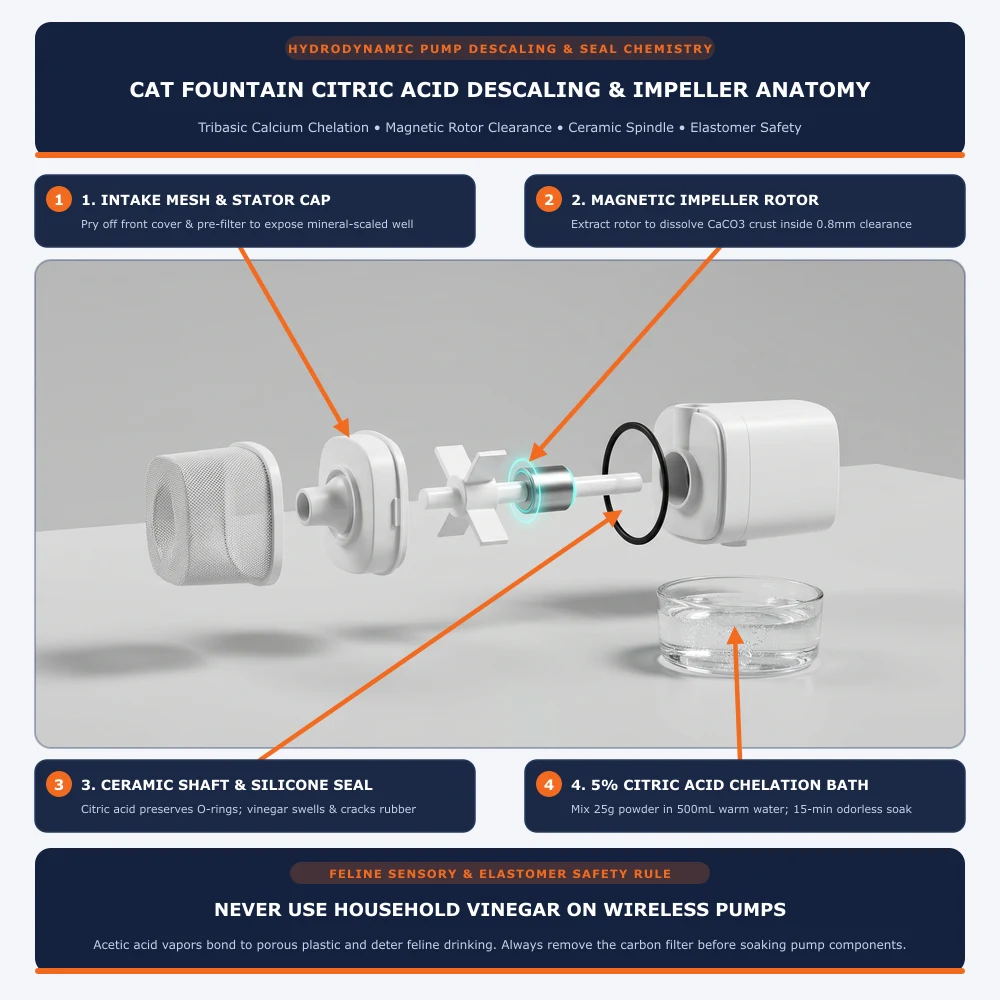
To safely descale cat water fountain citric acid formulations, follow this four-step laboratory-grade protocol every 4 to 6 weeks:
Step 1: Prepare the 5% Descaling Solution
Dissolve 25 grams (approximately 2 level tablespoons) of pure food-grade anhydrous citric acid powder into 500 mL (about 2 cups) of warm distilled or tap water (approx. 40°C – 50°C / 105°F – 120°F). Stir until the crystals are completely transparent. Warm water accelerates the reaction kinetics without warping plastic components.
Step 2: Disassemble the Magnetic Impeller Assembly
Unplug the fountain and remove the water reservoir. Pry off the pump faceplate and remove the impeller intake shroud. Using blunt tweezers or your fingernails, gently pull the magnetic impeller rotor straight out of the pump well. Inspect the ceramic shaft, the tiny rubber end-bushings, and the three-blade propeller for calcium scale.
Step 3: Targeted 15-Minute Acid Soak
Submerge the impeller rotor, ceramic shaft, pump faceplate, and stainless steel drinking tray into the warm citric acid bath. Pour 50 mL of the solution directly into the empty pump cavity. You will observe immediate effervescence as the acid reacts with CaCO3, releasing carbon dioxide bubbles. Allow the components to soak for exactly 15 to 20 minutes. Never use steel wool; use a soft nylon bottle brush or cotton swab to gently wipe away loosened mineral slurry.
Step 4: Neutralize and Flush with Fresh Water
Rinse all components under running cold tap water for 60 seconds. Reassemble the ceramic shaft, seat the rubber bushings snugly into their locating recesses, and reinsert the magnetic impeller. Fill the fountain basin with fresh water, install a fresh activated carbon filter, and power on the fountain. The pump should operate in whisper-quiet hydrodynamic equilibrium.
Preventative Maintenance: Protecting Impeller Telemetry and Water Flow
Smart pet fountains equipped with water-level radar and optical flow sensors rely on clean surfaces to maintain diagnostic accuracy. To extend the interval between descaling sessions:
- Use Filtered or RO Water: Switching to reverse-osmosis (RO) or zero-TDS pitcher water slashes mineral deposition by up to 90%, virtually eliminating limescale buildup.
- Routine Deep Clean Routine: Incorporate our specialized pump sanitation protocol by reviewing our walkthrough on how to clean smart pet fountain pumps to prevent slime and bacterial mold.
- Switch to Non-Porous Basins: Stainless steel surfaces resist mineral adhesion far better than polypropylene. Learn how material selection prevents feline chin breakouts in our analysis of stainless steel vs. plastic cat fountains.
- Track Daily Water Consumption: Ensure your pet drinks adequate fluids by correlating fountain flow data with the biometrics detailed in our guide to tracking cat UTI symptoms early with RFID smart water fountains.